

Business automation works best when the process is understood well enough to explain what should happen, who owns each decision, and how exceptions are resolved. AI can help interpret varied documents or messages, but it does not remove the need for clear workflow design.
Consider an illustrative company receiving supplier invoices by email. Staff download attachments, identify the supplier, compare details with an order, request approval, and enter the result into an accounting system. A useful automation might extract information and prepare a review packet. Automatically paying every document that resembles an invoice would be a very different and much riskier product.
This guide shows how to select a workflow, separate deterministic rules from model-assisted interpretation, connect systems, handle exceptions, and measure value. The goal is a process the business can inspect and operate, with AI used where it contributes rather than inserted into every step.
Key takeaways
- Map the real process and its exceptions before building integrations.
- Use deterministic rules for known policies and AI for interpretation that benefits from flexibility.
- Make ownership, approvals, retries, and exception queues explicit.
- Calculate value after including review effort, errors, support, and recurring operating costs.
Find a workflow with a clear owner and measurable friction
Look for repeated work with recognizable inputs and outcomes. Examples include classifying incoming requests, preparing account updates, extracting document fields, or reconciling information across systems. The best first candidate is often important but bounded, with someone who can explain what a correct result looks like.
Observe the process rather than relying only on a written procedure. Staff may use a spreadsheet to compensate for a missing field, call a colleague when a record is ambiguous, or postpone an action until an external confirmation arrives. These unofficial steps often contain the knowledge an automation needs.
Measure a baseline: volume, handling time, waiting time, error frequency, and the effort spent resolving exceptions. Separate active work from time spent in an approval queue. An automation can reduce typing while leaving the largest delay untouched.
Name a business owner who can resolve policy questions. Without that owner, developers may end up inventing rules from inconsistent examples. The first deliverable should be a shared process map and a clear definition of success, not a collection of connected tools.
Separate rules, interpretation, and judgment
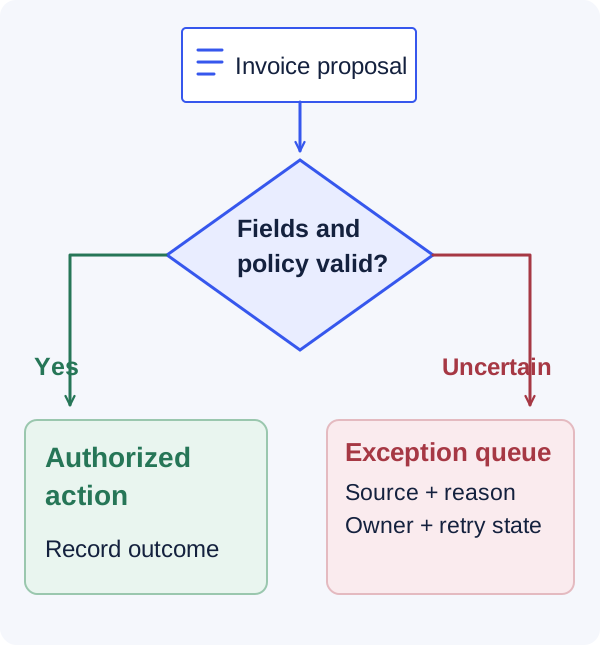
Some decisions are deterministic: an invoice must reference an existing supplier, a required field must be present, or an amount above an approved threshold needs review. Implement these rules explicitly so they remain inspectable and testable.
Other steps involve interpretation, such as identifying the intent of a free-text request or extracting a field from varied document layouts. These are plausible places for model assistance. The model’s output should still pass schema and business validation before it affects downstream systems.
A third category involves judgment, exceptions, or authority. Deciding whether to waive a contractual condition or approve an unusual payment may belong to a person. The workflow can prepare evidence and route the decision without pretending that language generation creates the necessary authority.
For every step, record the input, decision method, output, and failure behavior. This simple separation prevents a prompt from becoming an opaque replacement for the entire business process. It also makes it easier to improve one stage without rebuilding the whole workflow.
Design the data contract between systems
Define stable identifiers and the authoritative source for each field. An email address may identify a contact in one system but not uniquely identify a customer across the business. A supplier name extracted from a document may require matching against an approved record rather than creating a new supplier automatically.
Use structured intermediate records. For the invoice example, store the extracted fields, source document reference, matching result, validation findings, and review state. Keep the original evidence accessible to authorized reviewers so they can verify a disputed value.
Distinguish missing, unknown, and invalid information. An empty field should not silently become zero or a default account. These distinctions matter when downstream systems interpret values as instructions to update records.
Version the contract and validate both incoming and outgoing data. Integrations change, and a field that was optional may become required. A clear contract helps the workflow fail visibly when assumptions no longer hold instead of writing plausible but incorrect information into a business system.
Use model output as a proposal that must be checked
Ask the model for a constrained result appropriate to the task, then validate it in ordinary application code. Check types, allowed values, required evidence, and relationships to existing records. A valid JSON object can still contain the wrong supplier or an unsupported conclusion.
Preserve uncertainty in a useful form. Rather than trusting a self-reported confidence number alone, check whether fields match authoritative data, whether required evidence is present, and whether multiple sources agree. Route unresolved cases to review.
Test documents and messages that are unusual but realistic: missing pages, rotated scans, duplicate attachments, ambiguous dates, and instructions embedded in the content. Treat those embedded instructions as data, not permission to change the workflow or disclose information.
Keep prompts and models versioned with the workflow. When a model changes, rerun representative examples and compare extraction, routing, and downstream outcomes. A provider upgrade should not silently change the meaning of business records without verification.
Build connectors with least-privileged access
Give each integration only the capabilities needed for its role. A workflow that reads customer information should not receive an unrestricted administrator credential if a narrower access path exists. Separate environments and keep secrets in managed configuration rather than scripts or shared documents.
Enforce organization and resource boundaries within the connector. Do not rely on the model to select only permitted records. The application should resolve the current authorized scope and reject requests outside it before contacting a downstream service.
Plan credential rotation, revocation, and ownership. Integrations often outlive the employee who first connected them. The business needs to know which account owns the connection, how access is renewed, and what happens when that account changes.
Record connector activity with appropriate privacy controls. Operators should be able to identify which record was read or changed, by which workflow version, and under which authorization. Avoid storing complete sensitive payloads when identifiers and structured status are enough to investigate.
Have a repeatable process worth automating?
Walk us through the task, the systems, and the exceptions. We can help scope a bounded first workflow.
Make approvals concrete and easy to review
An approval step should present the proposed action and the evidence required to judge it. For an invoice, that may include supplier identity, amount, matched order, discrepancies, and the original document. A reviewer should not have to open several unrelated systems merely to understand what they are approving.
Keep the approved proposal stable. If a field changes after review, the workflow should revalidate whether the approval still applies. Bind execution to the reviewed version and record who approved it and when.
Define escalation and expiry. A request may wait while the underlying order changes or a customer withdraws the request. The system should detect stale approvals and make the next action clear rather than executing an old decision without context.
Design review workload carefully. If nearly every item requires correction, the workflow may not be ready for broader use. Measure review time and error patterns, then improve the extraction or process. Human approval is valuable when it concentrates attention on real decisions, not when it becomes unpaid debugging of unreliable automation.
Handle retries and partial failure explicitly
Assume networks and external services can fail after an action has already occurred. Use stable operation identifiers and idempotent writes where possible. Before retrying an uncertain update, inspect the destination state or use the provider’s supported idempotency mechanism.
Track each workflow stage durably. Received, validated, awaiting review, approved, submitted, and completed are different states. Include failed and canceled states with enough context for recovery. A single generic error label leaves operators guessing which actions are safe to repeat.
Set retry limits and backoff. A provider outage should not create thousands of immediate requests or bury the useful evidence in repetitive logs. After bounded retries, route the item to a visible queue with an owner and a suggested recovery path.
Define compensation for partially completed work. If one system was updated and another was not, decide whether to retry, reverse, or request review. Reversing an external business action may require a new authorized operation rather than deleting a local record and pretending nothing happened.
Create an exception queue that supports real operations
An exception queue is part of the product, not an admission that automation failed. It should explain why an item stopped, show the relevant evidence, and offer permitted next actions. Grouping exceptions by cause helps operators resolve related issues efficiently.
Prioritize by business impact and age. A missing optional field and an urgent blocked customer request should not look identical. Provide ownership and status so two people do not unknowingly work on the same item.
Allow corrections through controlled interfaces and preserve the original values. The team needs to understand whether a problem came from the source document, model interpretation, matching logic, or an integration. That history supports both improvement and accountability.
Review recurring exceptions with the process owner. Some can be eliminated through clearer input forms or better upstream data. Others represent legitimate business judgment that should remain manual. The objective is a dependable process, not an exception rate of zero at any cost.
The uncertain case needs an owner
Calculate value using the whole process
Estimate the time saved on routine handling, then subtract review, correction, support, and maintenance effort. Include model usage, connector fees, infrastructure, and the cost of failed or repeated work. A narrow calculation based only on automated extraction time can overstate the business benefit.
Use an illustrative calculation to make assumptions visible. If a workflow saves several minutes on an ordinary item but a substantial share requires lengthy review, the net result depends on the actual mix. Replace planning assumptions with observed pilot data before making a large rollout commitment.
Measure quality alongside speed. Incorrect updates can create downstream costs that are not visible in the automation dashboard. Track rework, duplicate actions, customer complaints, and reconciliation differences where relevant.
Compare the automation with a simpler alternative. A better form, a standardized template, or a deterministic integration may solve much of the problem without model uncertainty. AI earns its place when it improves the complete workflow relative to those options.
Roll out one bounded workflow and improve from evidence
Begin with a controlled volume and a reversible scope. Run in observation or draft mode if that helps compare results with the existing process. Agree on acceptance criteria with the business owner before reviewing outcomes so success is not redefined after the pilot.
Provide an immediate way to pause the automation and continue the original workflow. Operators should know when to use it and how to handle items already in progress. A pause should not leave records stranded without an owner.
Expand only after the process is understandable, useful, and supportable. Add new document types, business units, or write capabilities individually so the team can identify the effect of each change. Keep improving upstream data and user interfaces as well as model behavior. The strongest automation often becomes simpler over time because the business learns how to make its process more explicit.
Frequently asked questions
Which workflow should we automate first?
Choose repeated work with a clear owner, observable inputs and outcomes, and manageable consequences. Prefer a workflow with enough volume to measure but a bounded scope for recovery. Avoid starting with an ambiguous cross-company process where no one can agree on the correct result.
Do we need an AI agent for business automation?
Not always. A fixed workflow with a model used for extraction or classification may be easier to control and evaluate. Use an agent when the sequence of steps genuinely depends on what is discovered. Keep deterministic rules and consequential permissions outside the model either way.
How much human review should remain?
It depends on consequence, uncertainty, and measured performance. Start with review where needed and reduce it only for well-understood cases supported by evidence. Keep exceptions visible and sample automated results. Review should protect important decisions without forcing people to recheck every detail indefinitely.
Can we connect existing tools without replacing them?
Often, yes, if they provide suitable APIs, exports, or supported integration mechanisms. Assess access, data quality, limits, and ownership first. The workflow should use stable contracts and a recovery plan. Unsupported screen automation may be a temporary option, but it carries additional fragility and maintenance.
Let’s work through your next step.
Tell us what you’re building, what you’ve tried, and where you need a hand. We’ll work with you to define a practical way forward.