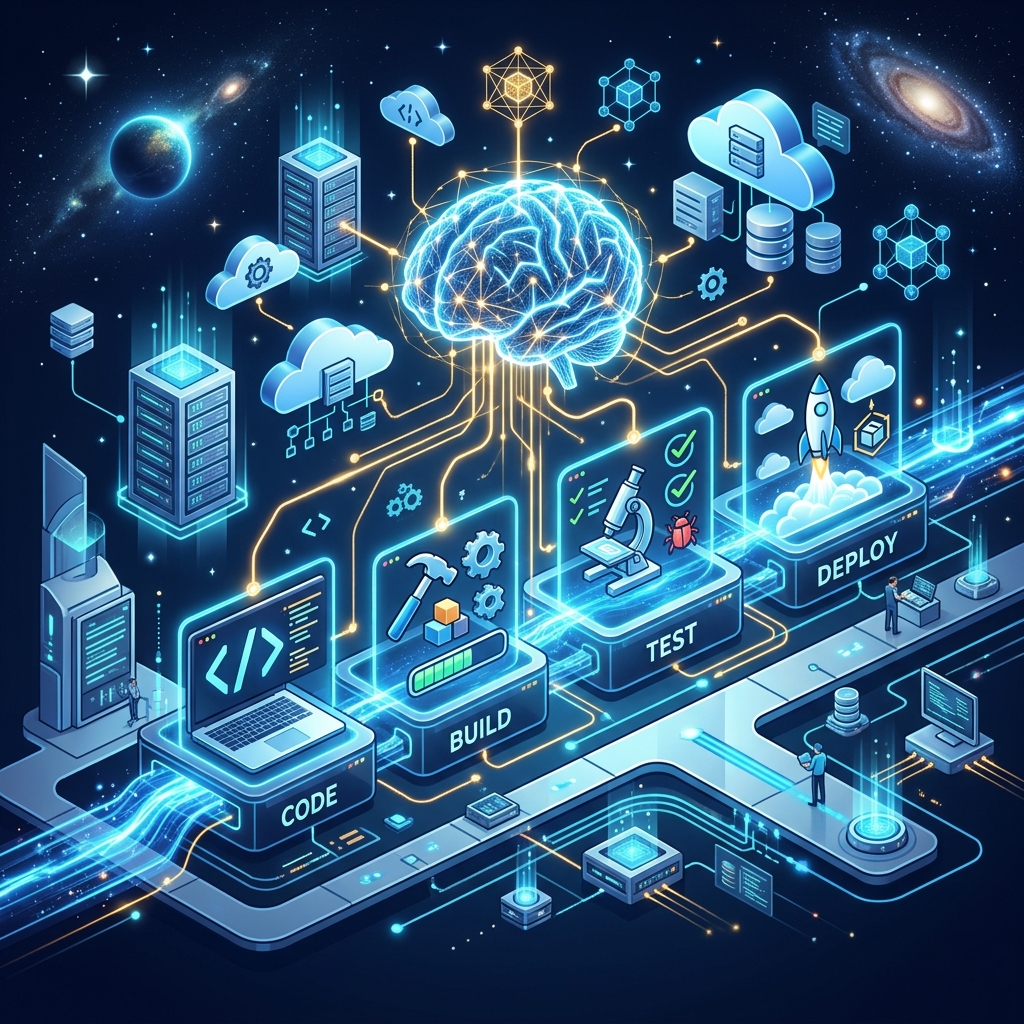
The era of simple, prompt-and-response chatbots is dead. While tools like the original ChatGPT demonstrated incredible linguistic capabilities, they were inherently passive systems—digital encyclopedias waiting to be queried. Welcome to the era of Agentic AI. Unlike standard Large Language Models (LLMs) that merely return text strings, Agentic AI systems possess genuine agency: the technical ability to plan, utilize external tools, execute complex multi-step workflows autonomously, and self-correct errors to achieve high-level business goals. At Mubbits, we are at the absolute forefront of engineering these autonomous digital workers for enterprise clients.
From Stochastic Parrots to Digital Workers
To understand the shift, consider a standard prompt: "Research our top 3 competitors and write a financial summary." A standard LLM will hallucinate a guess based on its frozen, outdated training weights. It is guessing the next most probable word.
When you assign the exact same task to an Agentic AI system engineered by Mubbits, it behaves like a human analyst. It actively triggers a headless browser (using Playwright or Puppeteer) to scrape the live web. It reads current SEC 10-K financial filings. It spins up a secure Python Docker container to execute data analysis scripts, generates accurate graphical charts, verifies its own math against strict constraints, and uses the SendGrid API to email a perfectly formatted PDF directly to your executive team. The AI is no longer just talking; it is doing.
The Architecture of Autonomous Agents
Building these resilient systems requires moving far beyond basic OpenAI API wrappers. The engineering team at Mubbits constructs robust, fault-tolerant multi-agent systems utilizing advanced orchestration frameworks like LangGraph, AutoGen, and CrewAI. We do not just pass text strings back and forth; we build complex directed graphs that dictate exactly how agents pass data payloads between each other.
# Example: Defining a specialized Tool for a Mubbits Agent
from langchain.tools import tool
from pydantic import BaseModel, Field

class RefundInput(BaseModel):
    transaction_id: str = Field(..., description="The Stripe transaction ID to refund")
    amount: float = Field(..., description="The partial or full amount to refund")

@tool("stripe_refund_tool", args_schema=RefundInput)
def stripe_refund_tool(transaction_id: str, amount: float) -> str:
    """Uses the Stripe API to issue a refund securely."""
    # The agent autonomously generates the exact JSON to trigger this code
    stripe.api_key = get_secure_env("STRIPE_KEY")
    try:
        refund = stripe.Refund.create(charge=transaction_id, amount=int(amount * 100))
        return f"SUCCESS: Refund {refund.id} processed."
    except Exception as e:
        return f"ERROR: Failed to process refund. Reason: {str(e)}"
1. Advanced Planning & Reasoning (ReAct)
Our agents utilize the ReAct (Reason + Act) cognitive architecture. The LLM acts as the central orchestrator, outputting a specific, machine-readable JSON schema that dictates its next move. It "Reasons" about the problem, "Acts" by selecting a tool from its registry, observes the output, and iteratively plans the subsequent step. Crucially, if a tool fails (e.g., a 404 API endpoint), the Mubbits agent recognizes the failure and autonomously formulates an alternative strategy to complete the objective.
2. Deterministic Tool Calling (Function Calling)
Tool calling is the bridge between the neural network and the real world. We define strictly typed JSON schemas (via OpenAPI specs) for enterprise functions. The LLM does not execute the code itself; rather, it intelligently generates the exact arguments required to call your backend infrastructure. A Mubbits-built agent can trigger Stripe payment refunds, execute complex PostgreSQL database migrations, or orchestrate AWS Lambda deployments. We enforce absolute security by using validation libraries like Zod, guaranteeing that the LLM's output precisely matches expected data types before any execution occurs.
3. Infinite Memory (RAG & Vector Databases)
A digital worker is useless if it suffers from amnesia. We implement sophisticated hybrid search architectures to give agents infinite, highly accurate context. The Mubbits team utilizes high-performance vector databases (Pinecone, Qdrant, Milvus) combined with state-of-the-art semantic embedding models (text-embedding-3-large). We fuse this vector search with traditional graph databases, allowing the agent to understand both the semantic nuance of enterprise documents and the explicit, hard-coded relationships between corporate entities.
Deploying Agentic AI Safely in the Enterprise
The technological challenge is no longer determining if an AI can accomplish a task, but guaranteeing that it does so securely, compliantly, and consistently. Handing the keys to your database to an autonomous system carries immense risk. Hallucinations in a chatbot are annoying; hallucinations in an agent that has write-access to your production SQL database are catastrophic.
This is where Mubbits' architectural expertise shines. We build systems with mandatory "Human-in-the-Loop" (HITL) checkpoints. For example, we can deploy an autonomous enterprise sales agent that drafts personalized proposals, negotiates pricing boundaries via email, and constructs legal SLAs. However, the system is architecturally hardcoded to pause and require a human manager to click "Approve" before sending binding contracts. This provides the massive leverage of AI scale with the absolute safety of human oversight.
The Financial Impact of Agentic Adoption
Companies that integrate Agentic AI are not just saving time; they are fundamentally altering their profit margins. By replacing tedious manual data entry, customer support triage, and basic coding tasks with highly scalable digital agents, enterprises can reallocate their human capital toward high-level strategic planning and creative problem-solving. This isn't theoretical—Mubbits is deploying these systems into production today.
Partner with Mubbits to Automate the Impossible
Agentic AI is the most significant technological leap since the cloud. Organizations that adopt these autonomous systems will drastically outpace their competitors in efficiency, output, and operational margins. Mubbits is a premier AI engineering agency capable of bringing these theoretical architectures into highly secure, production-ready enterprise reality. We do not experiment; we architect solutions that drive immediate, measurable business value.