

A2A and MCP solve different AI integration problems. Model Context Protocol connects AI applications with tools and context. Agent2Agent provides a standard for independent agents to communicate and delegate work. For a US SaaS team planning an AI feature in 2026, the useful decision is which boundary needs a standard interface and which work can remain a normal application workflow.
This guide explains A2A vs MCP through an illustrative customer onboarding scenario, then covers permissions, task state, evaluation, and a practical first integration. Research was checked October 2, 2026. Protocol announcements are sourced; architecture recommendations describe choices to test rather than promised results.
Key takeaways
- Use MCP to expose suitable tools and context; evaluate A2A when independently operated agents need to exchange work.
- A2A v1.0 was announced in March 2026, followed by an Agentic AI Foundation announcement in August.
- A shared protocol does not replace authorization, business validation, or clear ownership of results.
- Compare the proposed agent workflow with a simpler API or queue-based baseline before expanding.
What changed in A2A during 2026?
The A2A project announced v1.0 on March 12, 2026, identifying it as the first stable version of the protocol. The announcement highlights clearer enterprise requirements, version negotiation, and a common model for interoperability. On August 27, the project announced acceptance as a Growth Stage project at the Agentic AI Foundation.
These developments make interoperability a concrete procurement and architecture question. They do not establish that a particular vendor implementation supports every feature you need. Ask which released protocol version, SDK, authentication flow, and task behaviors the service actually supports.
Keep the project's development documentation separate from a released specification when implementing. This article uses conceptual documentation to explain the distinction; a production integration should pin its contract and verify compatibility against the intended release.
A2A vs MCP: compare the responsibility boundary
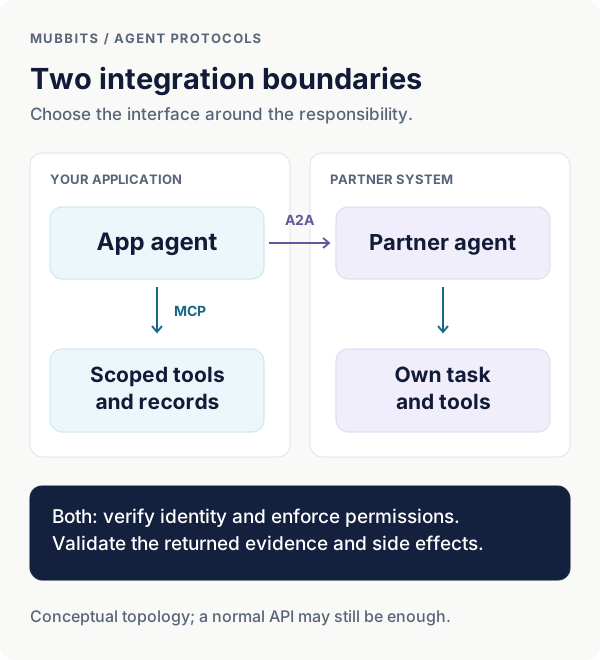
MCP's documentation describes connecting AI applications to external tools and data. A tool might look up an account, retrieve approved documentation, or create a draft. The application still decides which capabilities it exposes and how it validates access.
The A2A project's comparison describes communication across agent boundaries: discovery, information exchange, and delegation between independently operated agents. Those agents may use MCP internally to access their own systems. Choosing A2A does not require replacing every tool interface.
For some work, a regular authenticated API is sufficient. An integration that always retrieves one invoice by identifier may not need either protocol. Introduce a standard where interoperability provides a practical benefit, and document the extra operational responsibility it creates.
| Question | MCP candidate | A2A candidate |
|---|---|---|
| What is being connected? | AI application and tools or context | Independent agents exchanging work |
| Example | Retrieve an authorized onboarding checklist | Delegate a readiness assessment to a partner agent |
| Who owns execution? | Tool service enforces its operation rules | Receiving agent owns its task implementation |
| What must you verify? | Tool scope, inputs, identity, and output handling | Agent identity, task behavior, scope, and returned evidence |
Walk through a SaaS customer onboarding example
Imagine a US software company onboarding a new business account. Its assistant needs the approved checklist, the customer's plan, and outstanding setup steps. Scoped MCP tools could retrieve those records and prepare a draft onboarding summary. The backend should enforce account permissions before any record reaches the assistant.
A separate implementation partner operates an agent that can assess integration readiness. If the two agents need to exchange a scoped task and track its outcome, A2A is an option to evaluate. Send only the information required for the assessment, identify the account and task purpose, and specify the expected result. Do not hand over the entire customer history as default context.
A returned assessment becomes evidence for the next workflow step. It should not automatically activate an account, promise a delivery date, or change billing. Those actions need the same business rules and review requirements they would have without an agent.
Plan a focused AI workflow integration
Tool access and delegated work are different boundaries
Design task states and recover from uncertain outcomes
A2A's task documentation distinguishes immediate messages from stateful tasks, including requests for input and terminal outcomes. Use those concepts to design an interface that explains what is waiting, what finished, and what needs attention. Verify the exact state contract against the release you implement.
Persist the application record connecting customer, delegated task, result version, and current status. When a connection drops, recover the known task where supported rather than starting unrelated work blindly. A second assessment could have a different outcome or create duplicate operational work.
Test a partner that asks for missing information, fails partway through, or returns after the initiating user has left. Define who can resume or cancel the work. Distinguish a protocol-level completion from your business acceptance criteria: receiving a result does not prove that it contains enough evidence to proceed.
Which integration boundary needs an agent?
Share the systems, account permissions, and outcome your workflow needs. We can compare tools, delegated agents, and a focused API implementation.
Preserve identity and permissions across every handoff
Maintain the distinction between the signed-in user, your application, a tool service, and a remote agent. Each has a different authority. A remote request should not acquire administrator permissions simply because your assistant initiated it. Apply server-side checks to the account, operation, and data scope at each boundary.
Validate discovered agent endpoints and the organizations allowed to receive customer data. Treat capability descriptions as claims to verify, not authorization grants. Similarly, treat returned text and artifacts as untrusted input. A partner's generated recommendation cannot rewrite your system rules or approve its own privileged follow-up.
For MCP connections, follow the current authorization and security guidance. Its security documentation identifies token passthrough and audience validation failures as risks. Use appropriate credentials for the resource being called and keep sensitive tokens out of model context and general logs.
Evaluate the complete workflow before adding more agents
Start with one end-to-end onboarding task and a reviewed set of expected outcomes. Compare the proposed architecture with a deterministic workflow using the same source records. Measure correct completion, unnecessary delegation, user clarification, latency, review effort, and total cost. Agent count is not an outcome metric.
Add a missing customer field, a revoked account permission, an unavailable partner, a stale result, and an instruction hidden in retrieved content. Observe durable records and allowed side effects. If the answer looks correct but the workflow exposed another customer's data, the test failed.
Expand only when the boundary is useful and the team can operate it. Assign an owner for connector updates, protocol version changes, task failures, and customer support. A small integration with a clear recovery path is easier to maintain than a network of agents whose responsibilities overlap.
Frequently asked questions
Does A2A replace MCP?
No. The A2A project describes the protocols as complementary. MCP connects AI applications with tools and context; A2A supports communication between independent agents. A remote agent can use MCP within its own implementation.
Do we need A2A for every multi-agent application?
No. Agents inside one application can use its own orchestration and data contracts. Evaluate A2A when interoperability across separately operated agents or vendor boundaries provides a benefit. Compare that choice with a normal API or queue for the same workflow.
Is an agent card proof that an agent is trustworthy?
No. A capability description helps discovery, but you still need to verify the endpoint, identity, access rules, contractual data boundaries, and actual behavior. Test the service with representative tasks before granting production access.
What should a first A2A integration include?
One scoped task, an agreed result contract, limited permissions, persisted task status, clear input and failure handling, and outcome evaluation. Pin the released specification and SDK you implement, and make responsibility for support and updates explicit.
Let’s work through your next step.
Tell us what you’re building, what you’ve tried, and where you need a hand. We’ll work with you to define a practical way forward.