

AI code review is most useful when it finds a consequential defect and supplies enough evidence for an engineer to assess it. A long list of plausible comments is a poor substitute for that. For SaaS teams using Claude or Codex, the review process should be built around the changed behavior, the affected users, and the exact revision being merged.
This guide explains the current managed review options, a practical pull-request checklist, and a way to measure review quality without counting noise as progress. Research was checked on October 6, 2026. The survey graph is a historical 2025 trust baseline, not a 2026 model benchmark or a measurement of MUBBITS projects.
Key takeaways
- Ask reviewers to identify a trigger, incorrect result, and supporting code evidence.
- Verify findings against the final pull-request revision.
- Measure actionable findings and missed defects separately.
- Keep CI, branch protection, and accountable release ownership around AI review.
The useful shift: from writing code to checking the change
An October 2 r/ClaudeCode discussion included a suggestion to use Codex to review Claude's work. That is a community workflow idea, not proof that a particular pairing finds more bugs. It reflects a useful engineering instinct: give the implementation a separate examination before accepting it.
The review should begin with the product requirement and the diff. An agent that only reads the author's success summary may repeat the same assumptions. Give it the affected interfaces, relevant repository constraints, and a clear request to investigate behavior rather than endorse the patch.
For a small SaaS team, review capacity can become the bottleneck when code generation speeds up. Adding automated comments helps only if they reduce uncertainty or expose defects that would otherwise escape. A tool that creates hours of low-value discussion can increase the cost of shipping even when its individual comments sound reasonable.
Reddit, October 2: suggestion to use one coding agent to review the other
What Claude and Codex currently document
Claude Code's managed Code Review documentation identifies a research preview for Team and Enterprise subscriptions, with availability exclusions for certain data configurations. It describes inline findings and repository guidance through CLAUDE.md or REVIEW.md. Local diff review is a separate option, so check which path your organization can actually use.
OpenAI documents Codex review for connected GitHub repositories, manual requests with @codex review, automatic review settings, and repository-specific rules in AGENTS.md. Its documentation also describes a separate Security Review research preview. Verify account access and configuration before designing a required workflow around either service.
These are documented delivery mechanisms, not evidence that every defect will be found. Keep existing required checks and reviewer responsibilities. Decide who investigates a finding, what happens when a review times out, and whether a service outage should delay a particular class of release.
Choose the integration that fits your repository and data requirements. A local review, a managed service, and an organization-owned CI job have different operating boundaries. Evaluate those boundaries explicitly rather than treating every review command as interchangeable.
Claude Code: managed review availability and repository customization
OpenAI: GitHub review setup, triggers, and AGENTS.md guidance
A trust baseline worth reading carefully
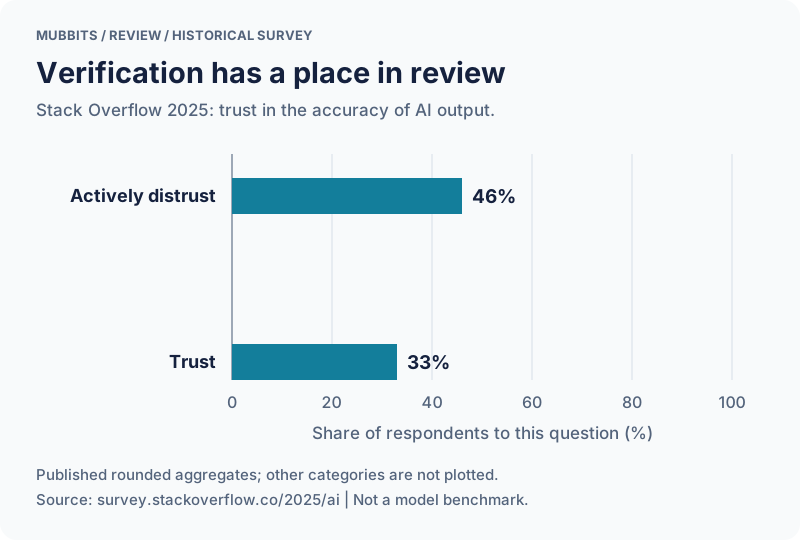
Stack Overflow's 2025 Developer Survey reports that 46% of respondents to its AI accuracy question actively distrusted AI output, compared with 33% who trusted it. These are rounded survey aggregates. They describe respondent attitudes in 2025, not the defect-detection performance of today's coding agents.
The graph plots those two published figures on a zero-based percentage axis. It does not invent a third category by subtracting the rounded values, and it should not be read as a market-share chart. The relevant implication for review is modest: verification is part of a credible workflow, especially when engineers remain responsible for the result.
A skeptical reviewer does not need to reject every AI suggestion. They need a way to distinguish a real defect from a plausible story. Require concrete evidence, preserve uncertainty, and use tests or code analysis to resolve it. Confidence of wording is not a reliable severity scale.
| Response aggregate | Share |
|---|---|
| Actively distrust | 46% |
| Trust | 33% |
Stack Overflow 2025 Developer Survey: trust in AI accuracy
Historical developer trust in AI accuracy
Ask for a defect report that another engineer can verify
A useful finding names the triggering condition, the incorrect behavior, the affected code, and the practical consequence. For example: when the payment provider retries an event after a process restart, the in-memory deduplication set is empty, so the order is credited twice. That report gives the team something concrete to reproduce.
Require the reviewer to distinguish confirmed behavior from a hypothesis. A suspicious path can deserve investigation without being presented as an established exploit. Ask it to inspect callers and related code before deciding that a removed check has no replacement.
Keep line references attached to the current revision. A finding that points to an earlier diff can become misleading after a fix. Include the reviewed commit in the record and request a fresh pass over changed behavior when the author makes a material correction.
Avoid asking the agent to maximize the number of findings. That rewards speculation. Set a severity threshold based on consequences and leave formatting, import ordering, and other mechanical matters to deterministic checks.
Evidence-based pull-request review
Use on a fixed commit with the requirements and relevant code available.
Review PR [reference] at commit [SHA] against [requirements]. Focus on consequential defects introduced by the change. For each finding, identify the trigger, incorrect outcome, current file and line, affected users, and supporting evidence. Inspect relevant callers before concluding behavior is broken. Separate confirmed defects from hypotheses. Do not manufacture findings to reach a quota. Report which checks you actually ran and what remains unverified.Which defects should your review process catch?
Bring a representative change and the behavior it must preserve. We can help define focused review rules, verification evidence, and release checks.
A SaaS pull-request checklist focused on behavior
Use a short checklist that reflects your product's recurring risks. A multi-tenant billing service needs different review emphasis from a marketing page. The table below is an original review aid for application changes; it is not a claim that every pull request needs every category.
Start with the boundary the change crosses. Does it read another account's records, move money, write data, change a public API, or alter a migration? Follow the resulting behavior through the surrounding code. Defects often live in the interaction between the changed function and an unchanged caller.
For each relevant category, ask what evidence would disprove the finding. A reviewer should be willing to withdraw a concern when a test or an existing invariant demonstrates that the case is handled. This makes automated review a useful conversation rather than a stream of unchallengeable assertions.
| Boundary | Question | Useful evidence |
|---|---|---|
| Tenant access | Can the new path select records outside the caller's organization? | A server-side authorization check and a cross-tenant rejection test. |
| Repeated requests | What happens after a retry or process restart? | Persisted deduplication and a duplicate-event test. |
| State changes | Can a partial failure leave conflicting records? | Transaction behavior, reconciliation, and failure fixtures. |
| Compatibility | Can existing clients still consume this response? | Contract examples and migration or versioning checks. |
| User interface | Can the intended user complete the task and recover from failure? | Keyboard behavior, error state, and a verified end-to-end path. |
| Deployment | Can old and new versions coexist during rollout? | Migration ordering and rollback constraints. |
Measure precision, misses, and reviewer effort separately
Count a finding as actionable only after an engineer verifies that it identifies a meaningful issue. Record rejected comments and why they were rejected. Review precision can be expressed as verified actionable findings divided by all findings assessed, with the sample size attached.
Precision alone is incomplete. A reviewer that reports one obvious bug may be precise while missing several serious defects. Use a separate set of representative changes with known bugs to examine coverage, and keep that evaluation distinct from live production review. Avoid claiming recall when you do not know how many real defects existed.
Track reviewer minutes spent investigating comments, correction time, and review turnaround. These measures help determine whether the system improves delivery. A higher comment count is not automatically a better result, and a shorter review is not better if it misses the risk that mattered.
Classify false positives by cause: missing context, misunderstood business rules, stale line references, or speculative edge cases. Fix the relevant source of noise. Adding a large instruction file after every false alarm can make the next review harder to interpret.
Keep security review and release authority explicit
General code review can identify security defects, but a sensitive change may need a dedicated threat-focused examination. Tell the reviewer which identities, data boundaries, and actions the change affects. An authentication refactor should not be reviewed with the same assumptions as a cosmetic component update.
Provide sanitized fixtures and scoped access. Review tools should not need live customer secrets to assess ordinary code behavior. If logs or traces are supplied, remove credentials and unnecessary personal data before they enter the review environment.
An agent's finding can justify a fix, but its silence does not certify safety. Keep the release decision with an accountable person or an established organizational process. Required tests, branch protections, and approvals should reflect the consequence of the change.
For a confirmed issue, add a regression check that exercises the failing behavior. A test that merely mirrors the revised function may pass without protecting the user outcome. Preserve the evidence that explains why the fix is necessary.
Introduce the process without overwhelming the team
Begin with a small repository or a bounded category of changes. Run the tool as an additional review input while engineers learn its strengths and failure modes. Establish a way to mark a finding as confirmed, rejected, or unresolved, and give unresolved reports a clear owner.
Keep repository rules short and consequential. Explain the few invariants that a reviewer cannot infer from the diff, such as compatibility with an older mobile client or a payment reconciliation requirement. Put local guidance near the code it governs so unrelated changes do not carry unnecessary context.
Review the process after enough pull requests to reveal recurring patterns. If comments are mostly noise, narrow the scope or improve the supplied context. If useful findings recur in one area, add a targeted check or improve the design so the defect becomes harder to introduce.
The goal is a better review system over time. AI should help the team find and understand problems, while the repository accumulates durable tests and clearer contracts. That is more valuable than making every pull request look as though it received an exhaustive audit.
Frequently asked questions
Can AI code review replace a human reviewer?
It can provide useful additional analysis, but release ownership and consequential decisions need an accountable process. Validate findings and keep required checks appropriate to the change.
How do we know whether an AI reviewer is useful?
Measure verified actionable findings, rejected comments, known-defect coverage, and reviewer effort. Attach the sample size and task mix. Do not use comment count as a quality score.
Should we run Claude and Codex on every pull request?
Only if the additional review has a clear purpose and its benefits justify the cost and investigation time. Start with a bounded pilot and use the second perspective where it addresses a specific risk.
Let’s work through your next step.
Tell us what you’re building, what you’ve tried, and where you need a hand. We’ll work with you to define a practical way forward.