

Claude Code versus Codex is a workflow decision as well as a model decision. For a SaaS team, the useful comparison is whether each agent can understand the repository, complete representative changes, produce verifiable evidence, and fit the team's review process at an acceptable operating cost. A model leaderboard alone cannot answer that.
Recent Reddit discussions about switching tools make this a timely question. This guide separates those community signals from documented capabilities, then gives a practical pilot for choosing one tool or using both. Research was checked on October 6, 2026. The cost graph is an explicitly hypothetical calculation, not a benchmark of either vendor.
Key takeaways
- Compare complete work on the same repository and starting commit.
- Record model, effort, tools, permissions, and environment alongside the result.
- Count human review and correction time when evaluating cost.
- A second agent can add a review perspective, but agreement does not prove correctness.
Why developers are reconsidering their coding workflow
An October 2 r/ClaudeCode discussion asked whether a website built with Claude should move to Codex. An October 5 r/codex post reported a much better experience after trying Claude Code. These are useful examples of the switching questions developers are asking, but they use individual projects, settings, and subjective assessments. They are not controlled measurements of speed or quality.
For a product team, the lesson is to preserve what already works and evaluate the specific friction. Is the problem incomplete changes, visual judgment, tool setup, review noise, or usage availability? A switch that improves one dimension can create onboarding work elsewhere. Identify the limitation before committing to a migration.
Community enthusiasm changes quickly after releases. Look for reproducible details such as the starting task, environment, model settings, and verification evidence. A claim that one tool is many times faster is difficult to apply when the two runs use different reasoning effort or different acceptance criteria.
Reddit, October 2: a website builder asks about moving to Codex
Reddit, October 5: one user's Claude Code and Codex comparison
Separate the model from the tools around it
A coding model generates decisions and code. The surrounding agent supplies repository access, commands, browser tools, context management, permissions, and the review interface. Two systems can use strong models yet behave differently because these surrounding capabilities differ.
Claude Code's overview documents codebase reading, file editing, command execution, and terminal, IDE, desktop, and web surfaces. Codex CLI documentation describes a local coding agent that can inspect a repository, make changes, and run commands. Check the specific surface your team will actually use; local and hosted environments need their own configuration.
For a fair pilot, provide each tool with the same acceptance criteria and comparable access. If one can run the integration suite while the other cannot reach a dependency, the result includes an environment difference. That may matter operationally, but it should be identified rather than attributed entirely to model intelligence.
Record restrictions that are part of normal team policy. An agent that succeeds only with production credentials or unrestricted network access may be unsuitable for your workflow. Evaluate success inside the boundaries you intend to keep.
Claude Code overview: documented surfaces and development capabilities
Use a comparison matrix based on your team's work
Organize the evaluation around actual work categories. A UI-heavy startup, a backend integration team, and a mature platform group may prefer different workflows even when they use the same models. The matrix below specifies what to inspect rather than assigning invented product scores.
Include the complete journey from prompt to reviewable change. A polished initial answer can still leave a missing migration, undocumented environment change, or broken deployment. Conversely, a slower run may be valuable if it produces a small, correct patch with clear evidence and little human repair.
Test the collaboration surface too. Engineers should be able to inspect diffs, understand proposed commands, recover a checkpoint, and identify what remains unverified. These activities happen repeatedly after the novelty of a first successful demo has passed.
| Work category | Example task | Evidence to inspect |
|---|---|---|
| Frontend | Add a billing-history filter. | Responsive behavior, keyboard interaction, and correct empty states. |
| Backend | Handle a duplicated webhook. | A persisted idempotency result and meaningful retry tests. |
| Maintenance | Upgrade a constrained dependency. | Compatibility checks and a limited, explainable diff. |
| Review | Inspect a realistic change with a known bug. | Specific findings, reproductions, and false-positive count. |
| Release | Prepare a staging build. | Actual build output, environment assumptions, and rollback notes. |
Run a small, controlled repository pilot
Choose several tasks from your own backlog with clear expected outcomes. Include a simple fix, a cross-file feature, a UI change, and a failure recovery task. Remove sensitive data and freeze the starting commit so each run begins from the same state. Keep the existing tool available while evaluating the alternative.
Use separate branches or checkouts for each run. Give the same task description, relevant documentation, and permitted tools. Record model and reasoning settings, elapsed time, interruptions, commands, tests, and reviewer corrections. If a run encounters an unrelated service outage, record that separately and decide whether a repeat is appropriate.
Ask reviewers to assess the changes against the acceptance criteria before seeing the cost calculation. This reduces the temptation to forgive an incorrect result because it was cheap or to prefer a costly run because it sounded sophisticated. Review the resulting software, not the confidence of the completion message.
A small pilot produces local evidence, not a universal ranking. Report the sample size and the task mix. When the results are close, workflow fit and repeatability may matter more than a tiny difference in average runtime.
A shared coding-agent evaluation task
Use the same task and starting commit in separate checkouts for each tool.
Implement [bounded feature] from commit [SHA]. Acceptance criteria: [observable behavior and edge cases]. Use [permitted tools and environment]. Preserve [compatibility constraints]. Read the relevant code and repository guidance, make a reviewable change, and run the checks needed to verify these criteria. Return a concise description of the diff, actual verification results, and remaining limitations. Do not claim tests passed unless you ran them successfully.Where does your development workflow get stuck?
Share the repository, task mix, and review constraints. We can help scope a coding-agent pilot around accepted work and practical delivery costs.
Compare cost per accepted change, including reviewer time
A useful internal metric is total pilot cost divided by accepted changes. Total cost can include agent spend, infrastructure, and human review or repair. Keep the categories visible so the team can distinguish a model expense from a slow review process. Subscription costs need a consistent allocation rule rather than an invented per-prompt price.
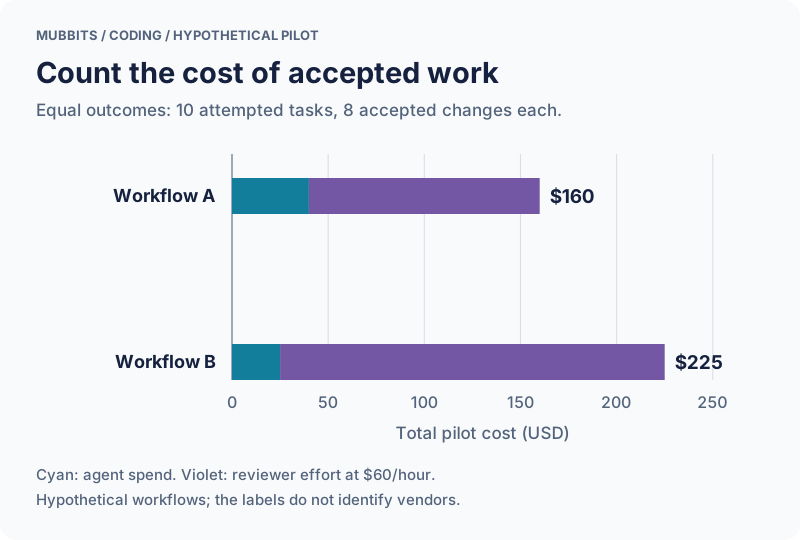
Here is a hypothetical example with ten attempted tasks and eight accepted changes in each workflow. Workflow A uses $40 of allocated agent spend and 120 reviewer minutes. Workflow B uses $25 of agent spend and 200 reviewer minutes. At an illustrative $60 per reviewer hour, A costs $160 in total and B costs $225. Their costs per accepted change are $20 and $28.13 respectively, rounded to cents. These labels do not identify Claude Code or Codex.
The graph deliberately shows both components with a zero-based dollar axis. It explains why a smaller agent bill can coexist with a higher completed-work cost. Replace every assumption with your own observed numbers; the example is not evidence that either vendor saves a particular amount.
Track rejected tasks and unfinished runs too. Omitting them can make a workflow look cheap by counting only its successes. Also distinguish first-pass acceptance from acceptance after substantial human rewriting, since those represent different engineering experiences.
| Measure | Workflow A | Workflow B |
|---|---|---|
| Attempted / accepted changes | 10 / 8 | 10 / 8 |
| Allocated agent cost | $40 | $25 |
| Reviewer time at $60/hour | 120 minutes = $120 | 200 minutes = $200 |
| Total cost | $160 | $225 |
| Cost per accepted change | $20.00 | $28.13 |
Agent spend is one part of completed-work cost
Keep repository guidance portable and concise
Store durable engineering facts in the repository: how to build, which checks matter, where sensitive boundaries lie, and what compatibility promises must be preserved. Keep tool-specific setup separate when the formats differ. Portability means the same engineering intent survives a switch, not that every configuration file can be copied unchanged.
OpenAI's September 11 prompting guidance recommends revisiting accumulated skills, AGENTS.md instructions, and task prompts as models improve. Its advice is a useful reason to remove stale procedures rather than adding a new rule after every failure. Long instruction files can hide the few constraints that actually determine correctness.
A practical rule should name the behavior and why it matters. For example: persist webhook deduplication before acknowledging the request, because retries can arrive after a process restart. That communicates a durable constraint better than a list of function names that may change during refactoring.
Maintain a short onboarding note for each tool, covering authentication, approved integrations, local dependencies, and recovery. Recheck those details after meaningful updates. A repeatable setup makes both daily work and future comparisons easier.
OpenAI, September 11: revisit skills, instructions, and prompting assumptions
Use a second agent where it adds a clear review perspective
One practical combination is implementation in the preferred coding tool followed by an independent review in the other. Give the reviewer the task requirements and the final diff, then ask for consequential defects with evidence. Do not ask it merely to agree with the implementation summary.
The second tool should have a defined job: inspect authorization changes, challenge retry behavior, assess the interface, or verify a specific migration risk. A broad review that repeats style preferences can create more work than it removes. Route deterministic formatting and type checks through ordinary tools.
Keep the review on the same revision that will be merged. If the implementing agent changes the code afterward, the earlier approval does not cover the new diff. Treat agent suggestions like any other review input: investigate them and preserve a human owner for the release decision.
Two agents can share blind spots because they see the same incomplete specification or use similar learned patterns. Agreement is useful input, but a reproducible failing test, a verified state transition, or a clear compatibility check is stronger evidence.
Make a decision that can be revisited
Choose a default tool for the work category where the pilot shows a consistent advantage. Keep exceptions explicit: a second tool might handle visual review, a particular integration, or overflow work. This avoids forcing every engineer to switch environments for each small task.
Set a review trigger rather than continuously chasing announcements. A major tool update, repeated failures on the same task category, a pricing change, or new team requirements can justify rerunning part of the pilot. Reuse the task set so the new result has a meaningful baseline.
Document the decision with its limits. State which repository and tasks were tested, what settings were used, and which outcomes improved. Avoid turning one team's experience into a general claim that one model or vendor always wins.
For a founder, the goal is a dependable delivery process. Tool choice should support smaller reviewable changes, clear ownership, and reliable releases. If both systems meet the required standard, familiar workflow and predictable operations can be a sensible deciding factor.
Frequently asked questions
Is Claude Code better than Codex for SaaS development?
The answer depends on your repository, task mix, tool access, model settings, and review process. Run comparable tasks from the same starting commit and evaluate accepted changes, human corrections, and total operating cost.
Can we use Claude Code and Codex on the same project?
Yes, provided you manage changes in separate branches or checkouts and keep repository guidance consistent. One can implement while the other reviews a fixed revision. Verify findings with tests and code evidence rather than treating agreement as approval.
Should model benchmarks decide which coding agent we buy?
Benchmarks can help identify candidates, but they do not measure your complete workflow. Include environment setup, verification, reviewer effort, recovery, and access policies in the purchasing decision.
Let’s work through your next step.
Tell us what you’re building, what you’ve tried, and where you need a hand. We’ll work with you to define a practical way forward.