

AI development ROI is the value of accepted software work compared with the full cost of producing it. Faster code generation is one input. Review, rework, subscriptions, integration effort, and escaped defects determine whether that speed becomes a business benefit.
Stack Overflow published its 2026 Developer Survey results on October 6. The findings make this a timely moment to review an AI coding investment, but a popularity survey cannot establish your team's return. This guide turns the discussion into a measurement plan for SaaS founders, engineering leads, and product teams buying development services.
Key takeaways
- Measure accepted changes against comparable work, including review and correction time.
- Treat survey adoption figures as context, not a promised productivity multiplier.
- Separate capacity released from cash saved and from revenue actually earned.
- Use a small, representative pilot with quality thresholds agreed before results arrive.
What the 2026 Developer Survey actually tells buyers
Stack Overflow's launch summary reports that 73% of respondents who use AI coding assistants or agents use them daily. That denominator matters: this is not 73% of every developer or proof of a corresponding productivity gain. The survey's trust table also reports 48.0% choosing trust when output is easily verified.
Our interpretation is that verification belongs in the operating budget. A team can adopt assistants extensively while still needing substantial engineering judgment. Evaluate the whole delivery process rather than assuming frequent use means inexpensive delivery.
Keep the survey's limits separate from your experiment
The published methodology identifies 30,903 valid responses from 169 countries, collected from June 23 to August 5, 2026. Recruitment used Stack Overflow's sites and opted-in community email list. This is a community survey, not a randomized experiment comparing delivery teams. Question response counts also differ.
Use those findings to choose questions for your own pilot. Do reviewers spend more time checking unfamiliar code? Does generated test coverage catch meaningful failures? Are experienced engineers finishing tasks sooner, or only producing larger changes? Your repository, task mix, and acceptance criteria must supply those answers.
Write down the uncertainty in the initial business case. If the baseline excludes support incidents or unpaid overtime, the comparison will be misleading even when the spreadsheet arithmetic is correct.
Define an accepted change before measuring speed
For the pilot, define a completed unit as a change that meets its written acceptance criteria, passes relevant checks, survives review, and reaches the agreed release stage. Decide whether post-release corrections within a fixed observation window belong to that unit. Apply the same rule to the baseline.
Group similar tasks: a form validation fix, an integration with an unfamiliar API, and a permissions migration should not share one average. Use task descriptions recorded before work begins, so the team cannot reclassify difficult work after seeing the result.
Keep waiting time and hands-on time distinct. A change may require less implementation effort but wait three days for review. That can improve labor efficiency without improving customer delivery time. Capture both, alongside the number of requests actually accepted.
Calculate delivery savings with a complete cost worksheet
Use two comparable batches of accepted work. For each batch, add implementation, review, correction, and release effort. Multiply by your chosen fully loaded hourly cost, then add the attributable tool and infrastructure bill. Keep one-time setup costs visible instead of spreading them silently across an optimistic future volume.
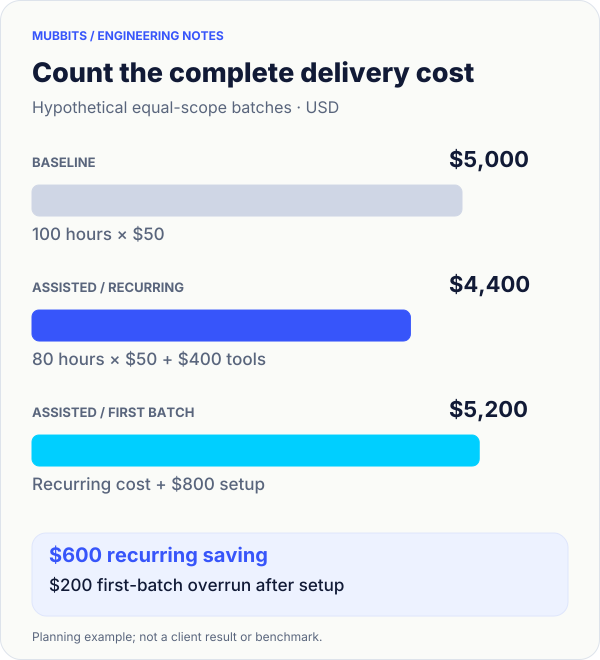
Here is a hypothetical example, not a MUBBITS client result or an industry benchmark. The baseline takes 100 total engineering hours at $50 per hour. The assisted batch takes 80 total hours, including its review and rework, plus $400 of allocated tool costs. Delivery cost falls from $5,000 to $4,400: a $600 difference, or 12% of the baseline.
If onboarding and integration consumed another 16 hours at the same rate, the first batch costs $5,200. Its net difference becomes negative $200. Later batches could recover that setup cost, but only if measured improvements continue. Do not present the recurring estimate as the first-month result.
| Cost component | Baseline | Assisted batch |
|---|---|---|
| All delivery labor | 100 hours × $50 = $5,000 | 80 hours × $50 = $4,000 |
| Allocated tool costs | $0 incremental | $400 |
| Recurring batch total | $5,000 | $4,400 |
| One-time setup | $0 | 16 hours × $50 = $800 |
| First-batch total | $5,000 | $5,200 |
Budget AI product features by successful outcome
See the first-batch cost, not just the recurring saving
Track a small scorecard that cannot hide rework
Choose a handful of measures and keep their definitions stable. Cost per accepted change answers an economic question. Median and slower-end delivery times describe predictability. Rework hours and escaped defects reveal whether apparent speed creates debt for the next release. Review a few actual changes alongside the numbers.
For a small pilot, show the individual task observations as well as the median. A percentile from a tiny sample can look precise without being dependable. Record context such as a production incident, changed requirements, or an unusually difficult dependency upgrade.
Avoid lines of code as the headline outcome. A concise deletion can remove a defect, while a large generated patch can create maintenance work. Similarly, a high suggestion-acceptance rate says little about whether the delivered feature solves a customer problem.
- Economics: total attributable cost divided by accepted changes within each task class.
- Delivery: elapsed time from ready-to-start to the agreed release stage.
- Quality: correction effort and severity of defects found during the observation window.
- Team impact: review load, interruptions, and time spent recovering failed agent runs.
Is AI improving your delivery economics?
Bring a representative task, review process, and delivery baseline. We can help scope a pilot that measures accepted work, full costs, and release quality.
Run a four-week pilot with explicit decision rules
In week one, select a repeatable task class and establish a baseline from recent comparable work. Confirm that those historical records include review and corrections. If they do not, collect a fresh baseline instead of estimating missing hours from memory. Set a quality floor and decide what economic improvement would justify expansion.
During weeks two and three, use the chosen assistant on the scoped work and record the same measures. Keep reviewers, acceptance criteria, and task complexity as comparable as practical. Note training time and changes to tools or prompts. A before-and-after pilot can inform a decision, but cannot isolate every cause of a difference.
In week four, review results with the people doing the work. Expand only the task classes that meet the agreed cost and quality conditions. Revise or stop the others. Continue the defect observation window after the pilot if releases have not had enough real use to expose problems.
Connect saved capacity to a business outcome
Twenty engineering hours released does not automatically mean twenty hours removed from payroll. The team might use that capacity to reduce a backlog, improve reliability, or deliver a customer commitment sooner. Name that intended use and check whether it happened.
Keep a separate line for cash savings, a separate line for capacity, and a separate hypothesis for revenue impact. An earlier feature release does not prove additional revenue unless the business can connect adoption or sales to that release. Avoid adding all three together when they describe the same benefit.
When evaluating a development partner, request a sample acceptance checklist, review evidence, and a clear explanation of what is included in the quote. Ask how generated work is maintained after launch and how change requests affect scope. Those answers are more useful than a promise to ship an arbitrary percentage faster.
Frequently asked questions
How do you measure AI coding ROI?
Compare the value and total cost of comparable accepted work. Include implementation, review, rework, tools, and setup. Report recurring delivery savings separately from first-period results, and distinguish released capacity from actual cash savings.
Does the 2026 survey prove that AI makes teams faster?
No. Adoption and self-reported attitudes do not establish a causal productivity result for your team. Use the survey to frame questions, then measure your own task classes and quality outcomes.
Is a four-week pilot long enough?
It can expose workflow friction and provide early cost observations for frequent tasks. It is insufficient for rare tasks or long-term reliability conclusions. Extend measurement until the sample and post-release observation window fit the decision.
Should startups cut review to improve ROI?
Only remove a review step when evidence shows an alternative catches the failures that matter. Reducing visible review effort while increasing support work or defects can make the apparent saving disappear.
Let’s work through your next step.
Tell us what you’re building, what you’ve tried, and where you need a hand. We’ll work with you to define a practical way forward.