

Claude Opus 5.5 vs GPT-6.1 Sol comes down to the work you need accepted, the time you can wait and the cost of getting there. Opus leads the sampled overall intelligence and production-code quality results. Sol has lower standard API rates and a shorter wait for an answer in the sampled medium-effort speed test. Neither result establishes a winner for every application.
This researched comparison covers benchmarks, coding, response speed, API pricing, caching and long-context costs. We checked provider documentation, benchmark publishers and the supplied community discussion on September 30, 2026. The graphs are original MUBBITS artwork using attributed published data. We have not run a private head-to-head experiment; worked budgets and workflow recommendations below are our own illustrative calculations and analysis.
Key takeaways
- For cost-sensitive work with clear acceptance checks, evaluate GPT-6.1 Sol first. For difficult coding or analysis where corrections dominate the budget, evaluate Claude Opus 5.5 alongside it.
- Standard short-context API rates are $4 input / $20 output for Opus and $2 / $10 for Sol per million tokens. Equal token counts would make Sol 50% cheaper before other charges.
- Output tokens per second and time to first answer measure different things. In the sampled medium-effort comparison, Opus streams faster while Sol starts answering sooner.
- Keep benchmark version, effort, harness and fallback settings attached to every score. GPT-6 Sol and GPT-5.6 Sol results are not GPT-6.1 Sol results.
Quick comparison: Claude Opus 5.5 vs Sol 6.1
Both models accept text and images and generate text. Their context and output limits are similar enough that task quality, integration behavior and actual operating cost usually deserve more attention than capacity alone.
Use the exact API identifiers below when collecting results. A saved model picker label, an older article about Sol or a default that changes between runs can invalidate a comparison. Context capacity also does not establish how accurately a model will find one important fact inside a large input.
| Specification | Claude Opus 5.5 | GPT-6.1 Sol |
|---|---|---|
| Provider | Anthropic | OpenAI |
| API model ID | claude-opus-5-5 | gpt-6.1-sol |
| Context window | 1,000,000 tokens | 1,050,000 tokens |
| Standard maximum output | 128,000 tokens | 128,000 tokens |
| Native input → output | Text and images → text | Text and images → text |
| Default reasoning effort | medium; adaptive thinking always on | medium |
Coding benchmarks: what FrontierCode actually measures
Cognition's FrontierCode 1.1 Main leaderboard reports a 54.6% weighted score for Opus 5.5 and 50.2% for GPT-6.1 Sol, both at medium effort. Mean cost per rollout is $0.80 and $0.36 respectively. Opus leads by 4.4 percentage points; Sol's reported rollout cost is 55% lower.
The score aggregates rubric criteria and is distinct from the leaderboard's pass-rate column. Main contains 100 tasks. Harnesses can differ, and the best-effort rows compare complete agent configurations rather than isolating the model. These costs belong to that evaluation.
For a product team, this is a useful tradeoff to investigate: does the extra code quality save enough developer review time to justify the higher run cost? A task with fast, reliable checks may suit Sol. A migration with subtle behavior changes may justify a trial of Opus. That recommendation is an inference, not a result measured on your repository.
| Reported metric | Opus 5.5 · medium | Sol 6.1 · medium |
|---|---|---|
| Weighted score | 54.6% | 50.2% |
| Mean cost per rollout | $0.80 | $0.36 |
Independent intelligence benchmarks: compare the same effort
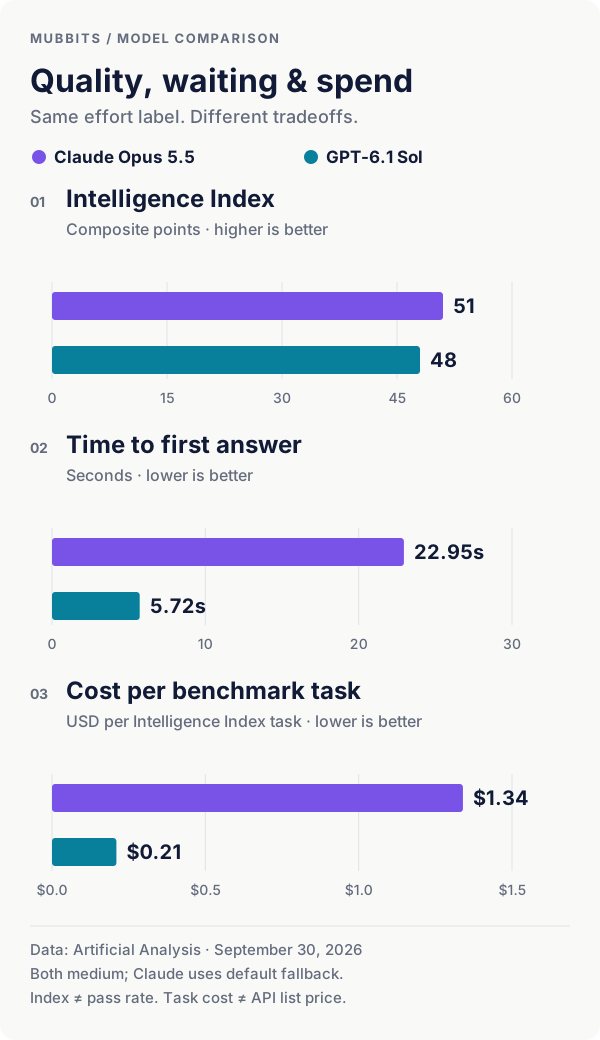
Artificial Analysis's release comparison reports Intelligence Index scores of 58 for Opus at max with default fallback and 52 for Sol at max. At medium, the scores are 51 and 48. These are composite index points, not percentages of coding tasks solved. Its benchmark-task costs also differ substantially from a fixed-token price comparison.
The Claude configurations include default fallback, so another model can participate. Matching the word medium does not mean matching compute. Read the graph and table as evidence about the published configurations, with quality and spend visible together.
A broad index is a starting point for deciding what to test. It does not tell you whether either candidate will preserve your design system, notice an undocumented business rule or correctly complete an integration. Those are acceptance criteria your team must supply.
| Published metric | Claude Opus 5.5 | GPT-6.1 Sol |
|---|---|---|
| Intelligence Index · medium | 51 points | 48 points |
| Intelligence Index · max | 58 points | 52 points |
| Cost per index task · medium | $1.34 | $0.21 |
| Cost per index task · max | $5.98 | $0.72 |
Business workflows and documents: benchmark winners can change
OpenAI reports that Sol at medium scores 2.2 percentage points above Opus 5.5 on AutomationBench at roughly one-third the cost. It also reports higher GDP.pdf scores than Opus with fallbacks across tested reasoning settings. On Terminal-Bench Science 0.1 at maximum effort, its reported average task costs are $5.47 for Sol and $23.21 for Opus.
These are OpenAI's published comparisons, which use its research environment or API and publicly reported competitor results. They are not a uniform independent retest. The document, workflow and scientific evaluations also measure different abilities; a cost figure alone does not establish which model has the higher score.
For document-heavy features, create questions whose answers depend on tables, footnotes and conflicting revisions. For business agents, score whether the correct record changed and whether failures were recovered. A convincing explanation after an incorrect tool action should fail that test.
OpenAI: GPT-6.1 Sol launch evaluations and comparison methodology
Speed: Opus streams faster, Sol answers sooner in this sample
At medium effort, the supplied Artificial Analysis comparison shows 72 output tokens per second for Opus versus 59 for Sol, but 22.95 seconds to first answer versus 5.72. Its 500-token end-to-end response estimates are 29.90 and 14.13 seconds. This is a dated measurement snapshot, not a latency promise.
Throughput describes generation once it starts. Users also experience input processing, reasoning and tool waits. A model can generate faster yet deliver a short answer later. Measure time to a usable result, including retries and review, for your product. The original graph below uses separate zero-based axes and the same medium configurations throughout.
| Speed measure | Claude Opus 5.5 | GPT-6.1 Sol |
|---|---|---|
| Output speed · higher is faster | 72 tokens/second | 59 tokens/second |
| First answer · lower is faster | 22.95 seconds | 5.72 seconds |
| 500-token response estimate | 29.90 seconds | 14.13 seconds |
Artificial Analysis: measured speed, latency and effort configurations
The same medium-effort comparison, three different measures
API pricing: input, output, caching, batch and fast modes
The table lists direct API text-token prices in USD per million tokens. Sol's standard input, output and cache-read rates are half of Opus's while the prompt stays within Sol's short-context tier. Actual requests may use different token counts and caching behavior.
Batch input and output are 50% below standard for both models. Fast mode doubles their standard rates. Anthropic advertises up to 2.5× speed for Opus fast mode; that is a provider claim about its faster mode, not evidence that it is 2.5× faster than Sol. OpenAI's launch announcement describes Sol Ultrafast as forthcoming, so it should not be treated as an established option in this comparison.
Cache reads and writes have different prices and eligibility rules. A recurring job may reuse a large context, but creating or refreshing that cache still has a cost. Subscription allowances in Codex, ChatGPT Work or Claude are separate from these API rates. Add tools, hosting and regional modifiers when estimating your bill.
| Billing category | Claude Opus 5.5 | GPT-6.1 Sol |
|---|---|---|
| Standard input | $4.00 | $2.00 |
| Standard output | $20.00 | $10.00 |
| Cache read | $0.20 | $0.10 |
| Cache write | $5.00 · 5 minutes; $8.00 · 1 hour | $2.50 · check cache policy |
| Batch input / output | $2.00 / $10.00 | $1.00 / $5.00 |
| Fast input / output | $8.00 / $40.00 | $4.00 / $20.00 |
OpenAI Docs: current API pricing
Anthropic: API pricing and long-context rules
Which model fits your actual AI workflow?
Bring your task examples, latency target and usage budget. We can help scope an evaluation of quality, completion time and cost per accepted result.
Long-context costs: why Sol is not always half the price
For Sol prompts above 272K input tokens, OpenAI doubles input and cache rates and multiplies output rates by 1.5 for the full request. Standard rates therefore become $4 input and $15 output per million tokens. Anthropic documents standard Opus rates across its full 1M context window.
Consider an original hypothetical repository analysis with 400,000 uncached input tokens and 5,000 total billable output tokens. Sol costs $1.60 + $0.075 = $1.675; Opus costs $1.60 + $0.10 = $1.70. Sol's token-only saving is about 1.5%, assuming identical token counts. The headline 50% saving no longer describes this workload.
Large context is sometimes necessary, but sending everything can increase both processing and distraction. Compare full-context runs against carefully selected files or retrieved excerpts. Preserve the information needed to solve the task, and verify that trimming did not remove a hidden dependency.
OpenAI Docs: Sol long-context threshold and full-request multipliers
Anthropic: standard pricing throughout the 1M context window
Worked monthly budget: 20,000 short-context AI requests
Suppose an internal assistant handles 20,000 requests per month. Each uses 12,000 uncached input tokens and 3,000 total billable output tokens, including any billed reasoning. At standard rates, Opus costs $0.048 + $0.060 = $0.108 per request; Sol costs $0.024 + $0.030 = $0.054. The token-only monthly estimates are $2,160 and $1,080.
This is an original budget illustration, not a customer result. It assumes equal token counts and one attempt per request, with no cache writes, tool fees, infrastructure, fast mode, regional modifiers or review time. Real agent loops can make several calls and accumulate context, so use actual usage records to replace these assumptions.
Cost per accepted result is total spend across all attempts divided by results that pass your checks. If every Opus request passes, Sol would reach the same token spend per accepted result at a 50% acceptance rate in this simplified example. That is a break-even calculation, not a prediction of either model's reliability. Review labor and deadlines can change the decision again.
| Calculated cost | Claude Opus 5.5 | GPT-6.1 Sol |
|---|---|---|
| Per request | $0.108 | $0.054 |
| 20,000 monthly requests | $2,160 | $1,080 |
OpenAI Docs: standard rates used in the calculation
What the Reddit, BenchLM and MyClaw comparisons add
The supplied r/codex discussion contains early, mixed personal impressions. One commenter favors Opus's coding while describing Sol positively; other replies ask about access or express stronger preferences. These are useful questions for a pilot, but the thread does not supply a shared task set, logs or controlled timing. We cannot turn it into a developer consensus or a measured win rate.
BenchLM explicitly distinguishes aligned, directional and non-comparable evidence. Its coding lane favors Opus while warning that the 90% intervals overlap. Its normalized scores use a different scale from Artificial Analysis; averaging the two would create an invented metric. Follow the underlying benchmark and configuration before interpreting a ranking.
MyClaw's article highlights lower Sol rates and the FrontierCode quality-versus-cost tradeoff. We traced that numerical comparison to Cognition's live leaderboard and verified it there. MyClaw is editorial context rather than an additional independent experiment. The practical lesson from these sources is to define what a better result means for your work before choosing a default.
Reddit: the supplied Sol 6.1 vs Opus 5.5 discussion
Which model should you choose for coding and AI agents?
Our recommendation is to shortlist Sol for frequent, bounded tasks with inexpensive verification, and Opus for workflows where complex judgment and correction time dominate. Examples include test generation or a routine report for the first group, and repository-wide refactoring or a difficult technical analysis for the second. These are evaluation priorities, not promises about a specific model's output.
Run a small representative pilot with the same starting files, requirements and available tools. Include routine cases, ambiguous instructions, a broken tool and a long input. Repeat tasks to reveal variability, and judge outputs against the same checklist without seeing the model name when practical. Keep unfinished and failed attempts in the denominator.
Track correctness, scope, time to accepted result, total billed tokens, fallback use and reviewer minutes. Set release gates before looking at results. If a Sol-first workflow escalates to Opus on a failed test or missing requirement, include both attempts in the cost. Stop escalating when the remaining uncertainty needs a person.
Before interpreting a failure as a quality problem, check compatibility. Sol requires the Responses API for tool calling and does not support none or minimal reasoning. Opus keeps adaptive thinking enabled and rejects forced tool choice. An invalid request configuration is an integration issue that must be corrected before a fair test.
Choose the simplest configuration that passes your acceptance criteria within the budget and deadline. Keep the model ID and reasoning settings with the evaluation record so that a later release can be compared against the same evidence.
OpenAI Docs: GPT-6.1 Sol reasoning and tool-calling requirements
Anthropic: Opus 5.5 integration changes
Build the pilot: evaluating AI agents before production
Frequently asked questions
Which is better: Claude Opus 5.5 or GPT-6.1 Sol?
Opus leads the sampled overall intelligence and FrontierCode scores. Sol has lower standard short-context API rates and a shorter sampled wait for a first answer at medium effort. Choose using accepted task quality, full completion time and total operating cost on your own workflow.
Is GPT-6.1 Sol cheaper than Claude Opus 5.5?
For equal token counts within Sol's short-context tier, its standard input and output rates are 50% lower. Above 272K input tokens its full-request rates increase, narrowing the gap. Retries, reasoning, cache writes, tools and review time also affect the total.
Which model is faster?
The sampled medium-effort Artificial Analysis comparison shows Opus generating 72 tokens per second versus Sol's 59, while Sol reaches its first answer in 5.72 seconds versus 22.95. These measures describe different parts of a response and do not guarantee your application's latency.
Which model is better for coding?
Cognition's FrontierCode 1.1 Main best-effort rows favor Opus's weighted score, while Sol costs less per rollout. The benchmark evaluates configured agents and code quality, so test both on your repository with the same acceptance checks before selecting a default.
Are these benchmarks original MUBBITS tests?
No. The article summarizes attributed evaluations from the benchmark publishers and OpenAI. The MUBBITS graphs are original presentations of that published data. Monthly budgets are hypothetical calculations, and the workflow advice is our analysis.
Are API prices the same as Claude or Codex subscriptions?
No. API prices describe billed token usage. Subscription access, allowances and client availability have separate terms. Check the actual plan and workspace settings before assuming an API estimate describes subscription usage.
Can I switch the model name in an existing agent?
Validate the integration first. Sol uses the Responses API for tool calling and restricts reasoning settings. Opus 5.5 keeps adaptive thinking enabled and rejects forced tool choice. Also test streaming, tool outcomes, permissions and failure recovery after switching.
Let’s work through your next step.
Tell us what you’re building, what you’ve tried, and where you need a hand. We’ll work with you to define a practical way forward.