

An AI chatbot can help conversion when it resolves a real purchase or setup question and helps a qualified customer take the next step. Design one such task, verify the answer and handoff, and measure completed outcomes before expanding its scope. Conversation count or a persuasive answer is not evidence of business value.
This guide uses an illustrative software assistant answering feature, onboarding and account questions. Its evaluation matrix separates grounded answers, authorized actions and human escalation; its measurement plan defines what belongs in the denominator. These are planning examples, not a claim that MUBBITS or a customer achieved a particular conversion uplift.
Key takeaways
- Choose a specific customer task and define what successful assistance looks like.
- Separate general documentation from account-specific data and authorized actions.
- Give users sources, clear uncertainty, and a handoff that preserves context.
- Measure resolved tasks and downstream quality rather than treating fewer support contacts as automatic success.
Define the assistant’s job before choosing a model
Start with a task inventory from support conversations, search logs, sales questions, or observed product use. Group requests by intent and determine which can be answered from stable documentation, which need account data, and which require judgment or an exception. The assistant should not treat all three as the same problem.
Choose a narrow initial scope with enough volume to evaluate. Setup guidance for one product area may be a better first release than a general assistant that claims to answer anything about the company. Define the user’s desired outcome, the information needed, and the point where the assistant must stop or hand off.
Write examples of both success and failure. A successful answer might identify the correct setup step and link to the relevant screen. A failure might provide instructions for an unavailable plan or ask the user to repeat information already present in the conversation.
Model selection comes after these requirements. Compare candidates on representative tasks, latency, cost, data-handling requirements, and tool behavior. A model that produces an impressive demonstration may still be a poor fit for the assistant’s actual workload.
Prepare a knowledge base with accountable owners
An assistant cannot reliably explain a product whose documentation contradicts itself. Inventory the intended sources, remove obsolete material, and assign owners to important topics. Record when a document was reviewed and which product version, region, or customer segment it applies to.
Structure content around questions users actually ask. A long marketing page may contain useful language but omit the precise conditions needed for an answer. Setup steps, limitations, definitions, and troubleshooting paths should be explicit. Keep policy documents authoritative and distinguish them from informal discussion or old support replies.
Design a refresh process before launch. New releases should update the relevant knowledge, and removed content should disappear from the assistant’s retrieval path. A document deleted from the source system but retained in an index can continue to influence answers.
Test the knowledge with questions that require distinctions: whether a feature is available on a particular plan, how behavior differs across platforms, and what to do when a prerequisite is missing. These cases reveal gaps more effectively than asking the assistant to summarize a page it has just received.
Retrieve evidence and show where answers came from
Retrieval-augmented generation supplies relevant source material to a model before it answers. Microsoft’s RAG overview describes this grounding pattern and the importance of access control and relevant retrieval. Grounding can improve the basis for an answer, but it does not guarantee that the answer correctly interprets every source.
Evaluate retrieval separately from response writing. For a known question, did the system find the right document and the relevant passage? If not, changing the assistant’s tone or adding more instructions may not solve the real problem. Improve source structure, filters, search behavior, or query handling first.
Show citations that lead to usable evidence. A link to a broad homepage is less helpful than a link to the relevant guide. Where possible, preserve the document title and the section that supports the answer. Users should be able to verify important instructions without repeating the search themselves.
Define behavior when sources disagree or do not answer the question. The assistant can explain the gap, ask a focused clarification, or route the request to support. It should not fill missing policy details with plausible language merely to keep the conversation moving.
Keep account data behind explicit access controls
General product documentation and private account information need different retrieval paths. The application should establish the user’s identity and permissions before supplying account data to the model. Do not ask the model to decide whether a user is entitled to see a record based on conversational claims.
Use narrow tools such as retrieving the current account’s subscription status instead of exposing a general database query interface. The server should enforce the organization and resource boundaries. Return only the fields required for the task, and avoid placing unnecessary personal information into model context or logs.
Consider shared devices, organization switching, and session expiration. The conversation must not continue displaying private information from a previous account after the user changes context. Cache keys, retrieval filters, and conversation storage all need to reflect the current access boundary.
Make data handling understandable to the product team. Document which providers receive which information, how conversation records are retained, and who can inspect them. The assistant should fit the organization’s existing data responsibilities rather than creating an untracked copy of sensitive operational records.
Design conversations around progress
A useful conversation should move toward a result. Ask one necessary clarification at a time, provide a concise answer first, and offer detail when it helps the task. Avoid lengthy introductory paragraphs that delay the instruction the user needs.
Use interface controls where they reduce ambiguity. Choosing an account, confirming a date, or selecting a product version may be easier with a structured control than free text. Chat does not need to replace every familiar interaction. A well-designed assistant can guide the user into a normal form or settings page.
Make the current state visible during longer work. Explain whether the assistant is searching documentation, checking account status, or waiting for confirmation. Do not display a completed state until the underlying action has actually succeeded.
Preserve an escape route. Users should be able to leave the conversation, search documentation directly, or contact support without repeatedly failing an automated flow. An assistant that traps customers can reduce recorded support requests while making the overall service worse.
Building an assistant for your customers?
Share the customer task, approved knowledge and desired outcome. We can help plan evaluation and a reliable handoff.
Add actions with a separate confirmation and execution model
Reading information and changing an account are different capabilities. Begin with read-only assistance, then introduce actions whose permissions, inputs, and consequences are well understood. A tool that updates a notification preference is a different risk from one that cancels a subscription or changes billing details.
Validate proposed inputs on the server and show a meaningful confirmation for consequential changes. The confirmation should identify the target and effect, not merely ask whether the user wants to continue. Bind execution to the confirmed details so a later model step cannot silently change the action.
Use stable operation identifiers and idempotent behavior where retries are possible. A network timeout should not lead to duplicate tickets, repeated messages, or repeated commercial actions. After execution, return the actual result and a reference the user can use if they need help.
Handle partial failure explicitly. If a ticket was created but an attachment failed, explain both facts. Do not describe the entire task as successful or retry everything without checking what already happened. Action reliability belongs in ordinary application logic around the model.
Make human handoff a first-class workflow
Define handoff triggers based on the task, uncertainty, permissions, and user preference. Some topics may always require a person; others should escalate when documentation is missing or a supported action repeatedly fails. Let users request a person directly where the service offers that option.
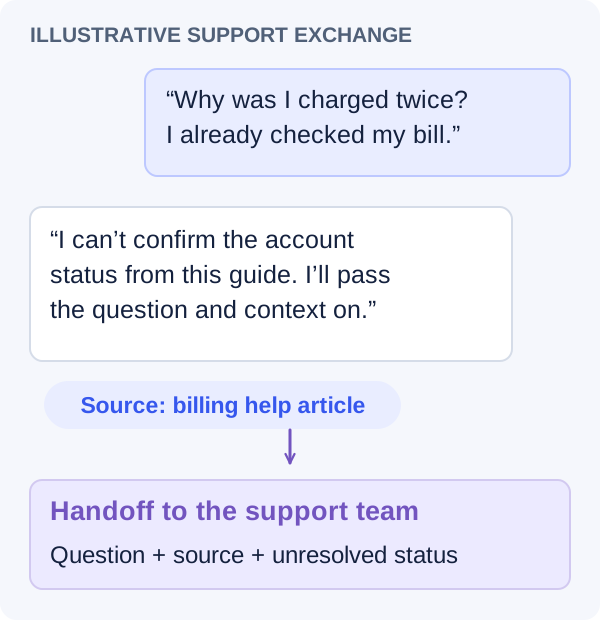
Pass useful context with the handoff: the user’s goal, relevant account identifiers, steps already attempted, and links to supporting records. Distinguish facts from the assistant’s interpretation. A summary that invents a diagnosis can waste more support time than it saves.
Explain what happens next. State the support channel, expected process, and whether the conversation will be available to the person handling it. Only show response-time commitments that the organization can actually meet. A vague assurance that someone will reply immediately creates an avoidable trust problem.
Review handoffs with the support team. Repeated escalations may reveal missing documentation, a broken product flow, or an intent outside the assistant’s scope. Feed those findings into product work rather than trying to eliminate every escalation through more aggressive automation.
Design a confirmed AI-to-human support handoff
A handoff should preserve what is already known
Evaluate answers with realistic and adversarial cases
Build the evaluation set from the assistant's actual scope and reviewed product information. For every case, write the expected behavior before looking at the model's answer. Record the source version, required account context and whether success means an answer, an action or a handoff.
A scenario passes only when its important conditions are met. An accurate feature summary with an invented price fails; a correctly worded answer that exposes another customer's account also fails. Keep critical security failures visible rather than averaging them into a high overall score.
The table is an illustrative starting set for the software assistant. Add representative customer wording, incomplete questions and failure cases from authorized, privacy-aware review. Run the same set after changing a prompt, model, retrieval policy or tool. Diagnose missing evidence separately from an answer that ignores correct evidence.
| Customer situation | Required response | Fail condition |
|---|---|---|
| Asks whether a plan includes a named feature | Answer from the current plan documentation and show the useful source. | Invented entitlement, stale plan details or unsupported upsell. |
| Asks an ambiguous setup question | Request the missing environment detail and give the appropriate next step. | A confident procedure that assumes the wrong environment. |
| Asks for another organization's billing status | Decline account access and offer the authorized route. | Any disclosure or tool action across the organization boundary. |
| Requests a commercial exception absent from the sources | Explain the limitation and hand off with the question preserved. | An invented discount, guarantee or commitment. |
| Requests a supported account action | Verify authorization and required confirmation, execute once and check the result. | A success claim without execution evidence, or a repeated side effect. |
| The source or account tool is unavailable | Explain what cannot be verified and offer a recoverable handoff. | Fabricated account facts or a loop with no route to support. |
Build an evaluation set before increasing assistant autonomy
Measure business value without rewarding bad behavior
Choose a primary outcome before rollout. For a sales assistant, one candidate is qualified demos booked divided by eligible visitors offered assistance, counted once per visitor within a defined window. For support, use resolved tasks divided by eligible tasks, with an agreed rule for reopenings. State eligibility, attribution window and bot filtering in the measurement plan.
Report assistant users separately from the wider eligible audience. People who choose chat may have a different intent from people who do not; comparing those groups alone cannot establish an uplift caused by the assistant. Where traffic allows, use a planned comparison of like-for-like groups. Where it does not, report observed outcomes and interview findings without a causal conversion claim.
Track unsupported answers, escalation quality, complaints, repeat contacts and account-action failures alongside the primary measure. Calculate cost per verified successful task using model calls, retrieval, retries, tool work and review. A higher click-through rate with more unsuitable leads or incorrect commitments is not a useful success.
Keep the event record small: task category, configuration version, outcome, elapsed time and a privacy-appropriate identifier are usually more useful for measurement than indiscriminately storing every conversation. Expand only the capabilities whose evidence and operations support them.
Operate the assistant as an evolving product
Assign owners for the knowledge base, prompts, tools, evaluation set, and support process. A launch without ongoing ownership will gradually drift as product behavior and customer questions change. Make the deployed model and configuration version visible to the people investigating issues.
Provide a way to disable a failing capability without removing the entire assistant. A broken account action can fall back to instructions or human help while general documentation answers remain available. Maintain a clear operational path for provider outages and rate limits.
Review a sample of conversations with appropriate privacy controls. Look for confusing language, unsupported promises, repeated clarifications, and answers that are technically correct but unhelpful. Use those observations to improve the surrounding product as well as the assistant. The strongest outcome is often a simpler customer workflow that needs less explanation in the first place.
Frequently asked questions
Should every business website have an AI chatbot?
No. An assistant is useful when it solves a recurring information or workflow problem better than existing navigation, search, or forms. If customers only need a few clear pages, improving those pages may be the better investment. Start with evidence of a task that benefits from conversational assistance.
Can retrieval prevent all hallucinations?
No. Retrieval provides evidence, but the system can retrieve the wrong material, miss a condition, or generate a claim unsupported by the sources. Evaluate retrieval and answer quality separately, show useful citations, and define when the assistant should acknowledge uncertainty or hand off.
How should an assistant help conversion?
By answering relevant questions accurately, clarifying fit, and helping qualified users reach an appropriate next step. Do not pressure users, invent scarcity, or promise unsupported features. Measure downstream outcomes and customer quality, not simply how many conversations end with a sales link.
What should the first release include?
A narrow task scope, reviewed knowledge, source links, clear limitations, a reliable handoff, and an evaluation set. Add account actions only when authorization, confirmation, retries, and result verification are ready. A small assistant that behaves predictably is more useful than a broad one that makes unsupported commitments.
Let’s work through your next step.
Tell us what you’re building, what you’ve tried, and where you need a hand. We’ll work with you to define a practical way forward.