

Agentic commerce lets an AI assistant help a shopper discover products and carry a purchase into a connected checkout. For US retailers, the practical question in 2026 is whether their catalog, inventory, checkout, and support systems can serve that journey reliably. A conversational interface cannot fix an inaccurate product feed or an order system that charges twice after a retry.
This guide compares Universal Commerce Protocol (UCP) and Agentic Commerce Protocol (ACP), then lays out a merchant readiness plan. Research was checked on October 2, 2026. Platform announcements and documented access requirements are distinguished from our engineering recommendations; the worked store example is illustrative.
Key takeaways
- UCP and ACP are commerce integration standards with different platform ecosystems; choose around the channel you can actually access.
- An open protocol does not mean every merchant is approved for a platform's checkout experience.
- Keep product facts, final prices, inventory, and order acceptance under merchant control.
- Pilot one catalog segment and measure completed, reconciled orders rather than assistant mentions alone.
What changed in agentic commerce during 2026?
Google announced UCP on January 11, 2026, describing a standard spanning discovery, buying, and post-purchase interactions. Its initial checkout announcement covered eligible US retailers in AI Mode and Gemini. On May 20, Google described further UCP features, including Universal Cart and planned checkout expansion across more surfaces. Those announcements are evidence of platform direction, rather than proof that every feature is enabled for your account.
OpenAI's current commerce documentation describes ACP integration and says Instant Checkout is available to approved partners. Its onboarding guide also identifies product feed access as partner-approved. Check the actual merchant onboarding path before allocating a launch date.
The business implication is that commerce data can be consumed outside your storefront. Product operations, engineering, merchandising, and customer support need a shared definition of a valid order, regardless of where the shopper starts.
Google: January 2026 UCP announcement and US eligibility
Google: May 2026 UCP and Universal Cart announcements
UCP vs ACP: which integration should a retailer prioritize?
Start with the customer channel and platform access. Google describes UCP as a shared commerce language across consumer surfaces, businesses, and payment providers. ACP connects merchants with ChatGPT commerce experiences, with checkout state and payment processing remaining on merchant systems. Neither description removes the need for a working commerce backend.
Treat the following comparison as a planning aid. It does not assert that every named capability is available to every merchant. Your commerce platform may provide an integration, which can be simpler than building the protocol endpoints yourself. Confirm what that integration covers before commissioning custom work.
| Decision | UCP | ACP |
|---|---|---|
| Starting ecosystem | Google's announced commerce surfaces and supporting platforms | ChatGPT commerce and merchant integrations |
| Access question | Is your retailer, platform, and target surface eligible? | Is your feed or checkout integration approved? |
| Backend requirement | Reliable catalog, checkout, and order operations | Reliable product data and merchant checkout operations |
| Pilot choice | One supported Google shopping journey | One approved ChatGPT commerce journey |
Make your product catalog answer real shopping questions
Imagine a US home goods store selling desk lamps. A shopper asks for a lamp that fits a narrow desk, supports a particular bulb, and arrives before a move. A feed that says only 'premium modern lamp' cannot answer those constraints. Useful facts include dimensions, compatible bulbs, included accessories, stock status, and the scope of delivery estimates.
Create a catalog audit that compares product records with the storefront and order system. Check variant identifiers, USD prices, image-to-variant matching, and availability. Assign an owner to resolve discrepancies. Keep measured product facts separate from promotional language and verify compatibility claims with the source catalog.
Describe returns and fulfillment clearly on crawlable product and policy pages. Avoid inventing answers to fill missing attributes. If a dimension or shipping restriction is unknown, repair the underlying product record. Improving the same source data can support both human shopping and machine interpretation.
Can your store support an AI checkout journey?
Bring your commerce platform, catalog, and order flow. We can scope a channel integration around access requirements, checkout validation, and a measurable pilot.
Keep checkout decisions on the merchant backend
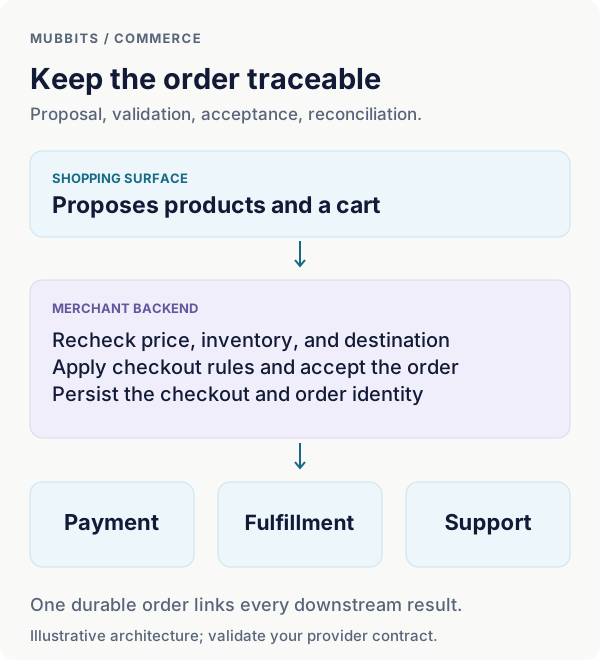
Separate a proposed cart from an accepted order. The assistant may suggest items, but your backend should revalidate the variant, quantity, inventory, shipping destination, and final amount before completion. Use your established calculation and payment services for shipping, discounts, taxes, and authorization. An amount written in generated text is not the transaction total.
OpenAI's documentation explicitly places checkout state and payment processing on merchant systems. Apply that responsibility boundary to your implementation plan: identify which service owns the quote, which accepts the order, and which confirms payment. Define the behavior when one service succeeds and the next times out.
In the lamp example, stock may change after the assistant displays a product. The checkout should return a recoverable availability change and a revised total when appropriate. It should never silently substitute another variant or charge the original amount after the buyer's accepted cart changes.
OpenAI: merchant checkout state and order handling
One order, with clear owners at each stage
Test retries, payment uncertainty, and duplicate orders
A timeout does not tell you whether a payment failed. Your integration needs a durable way to reconcile the checkout attempt with the order and processor result. Use the chosen protocol's current idempotency contract and persist operation identity across retries. Do not generate a fresh purchase attempt each time the interface reconnects.
Prepare a sandbox walkthrough for a response lost after successful payment, a duplicated webhook, an inventory change during checkout, and a declined payment. Verify the durable order records and transaction ledger after each case. A friendly confirmation message is not enough evidence.
Include post-purchase support in the pilot. Staff should be able to locate the order from the customer's confirmation, explain its status, and apply the store's established return process. Record the originating channel without splitting the order into a second, inconsistent customer record.
- A retried purchase produces one accepted order and the expected charge.
- An uncertain payment produces a reconciliation path before another attempt.
- A stale quote requires an updated buyer decision when material details change.
- Support can trace checkout, payment, fulfillment, and any refund to the same order.
Measure a US retailer pilot from discovery through support
Choose a small product group with reliable stock data and straightforward fulfillment. State the supported US shipping destinations and currency in the product experience. Keep operational exceptions visible to the team and use the existing checkout path as a fallback when the new channel is unavailable.
Track stages separately: product exposure where the platform reports it, referred sessions, checkout attempts, accepted orders, fulfillment, cancellations, and support contacts. Deduplicate channel events against the order ledger. A platform mention, click, or checkout start is not a completed sale.
Compare contribution after channel costs, returns, and support work with your existing journey. Do not assume the integration improves revenue until the pilot provides evidence. The useful first deliverable is a reliable order path and a measurement plan, followed by a decision to expand, repair, or stop.
Frequently asked questions
Do US retailers need both UCP and ACP?
Not necessarily. Prioritize the channel your customers use, the access your platform provides, and the capabilities your team can operate. A reusable catalog and order backend can reduce later integration work, but a dual-protocol launch adds scope without automatically adding customers.
Does adopting an open commerce protocol guarantee placement in AI shopping?
No. Protocol implementation, platform approval, product eligibility, and discovery are separate questions. OpenAI's current documentation identifies approval requirements, and Google's announcements describe eligible retailer experiences. Confirm access and measure actual exposure and orders.
Can we reuse our current payment processor?
Evaluate that with your commerce platform and the selected integration. OpenAI describes merchants processing payments on their own systems with their existing processor. Verify supported payment methods, risk checks, reconciliation, and the actual provider contract before promising a launch.
What should we fix before building agentic checkout?
Audit catalog accuracy, price and inventory freshness, checkout validation, duplicate protection, and support traceability. If the same product has conflicting prices or variants across systems, resolve those ownership problems before exposing another checkout channel.
Let’s work through your next step.
Tell us what you’re building, what you’ve tried, and where you need a hand. We’ll work with you to define a practical way forward.