

Claude Code usage limits and API bills need different troubleshooting paths. A subscription usage bar describes an allowance; a locally estimated session cost describes token consumption; an invoice describes actual billing. Treating those as the same number makes it harder to explain why a coding session runs out of capacity or becomes expensive.
October Reddit discussions show developers comparing unexpected limits, large sessions, and the cost of using several coding agents. This guide gives a practical diagnostic sequence for Claude Code, with lessons that also apply to other coding tools. Documentation was checked on October 6, 2026. The context-growth graph is an original token-count illustration, not a pricing forecast or a conversion from tokens to subscription quota.
Key takeaways
- Identify the account and billing path before interpreting a usage figure.
- Check context, retries, parallel work, and background activity before changing plans.
- Keep version and timestamps with a reproducible billing or allowance report.
- Measure useful accepted work alongside consumption; low token usage alone is not success.
What the latest community reports can tell you
An October 3 r/ClaudeCode post described a team's rising combined Claude Code and Codex consumption. The author pointed to large sessions and different model choices as possible contributors. An October 4 r/ClaudeAI post questioned why a higher plan appeared to exhaust its allowance faster. These are user reports and should not be converted into verified vendor billing behavior.
They identify questions worth investigating: which account is active, what changed in the workflow, and whether the displayed figure represents usage or money. A plan name alone does not establish that two sessions used equivalent models, context, or automation.
Avoid diagnosing an account from a screenshot of one percentage. Gather the session times, tool version, model, authentication method, and available account history. If the evidence points to an unexplained account discrepancy, preserve that record for vendor support rather than constructing a speculative explanation.
Reddit, October 3: team discusses combined coding-agent consumption
Reddit, October 4: user asks about Max plan allowance consumption
Start by identifying what the number measures
Claude Code's current cost documentation distinguishes the /usage session estimate from subscription-plan usage. It says that local dollar estimates are not subscription invoices and points API users to the Console for authoritative billing. That distinction is the first diagnostic step.
Check how the session authenticated. A subscription login, an API key, and a cloud-provider route can have different billing arrangements. Confirm the active organization as well; a developer can accidentally compare personal-plan activity with an employer-managed environment. Do not print secret keys while checking configuration.
Record the relevant time window. A current session estimate, a rolling allowance, and a monthly invoice cover different periods. Choose the account timezone deliberately when comparing records, and preserve exact timestamps for an unexplained discrepancy.
The table below separates the questions each signal can answer. It is a diagnostic map, not a claim that every product exposes the same fields. Use the documentation for the installed version and account rather than following an old screenshot from a tutorial.
| Signal | Useful question | Avoid assuming |
|---|---|---|
| Subscription allowance | How much of this plan window is available? | That the percentage converts to a fixed API dollar amount. |
| Session token estimate | What did this local run consume? | That it equals the subscription invoice or all-device activity. |
| Account invoice / billing history | What was actually charged under this account? | That it explains every individual workflow without attribution. |
| Task outcome log | Which changes were accepted and which needed repair? | That completion messages alone establish useful work. |
Claude Code: session estimates, plan usage, and authoritative billing
Trace one expensive session before changing the whole setup
Pick a recent run that the team considers unusually costly or allowance-heavy. Reconstruct its task, starting repository state, model settings, tool calls, retries, and accepted result. Look for repeated scans, large command output, unresolved build failures, and overlapping sessions.
Separate legitimate complexity from waste. A migration may need broad context and careful reasoning. A small copy edit probably does not need repeated full-repository inspection. The useful question is whether the run spent resources on information that contributed to the accepted change.
Keep the investigation bounded. Read the relevant usage records and selected trace entries rather than feeding every historical transcript back into another expensive session. Summarize the timeline with a few meaningful events and the evidence behind them.
Compare with a similar successful task if one exists. Match the repository and acceptance criteria as closely as possible, then examine what differed. An increase can come from task complexity, a configuration change, or repeated failure; it should not automatically be called a model regression.
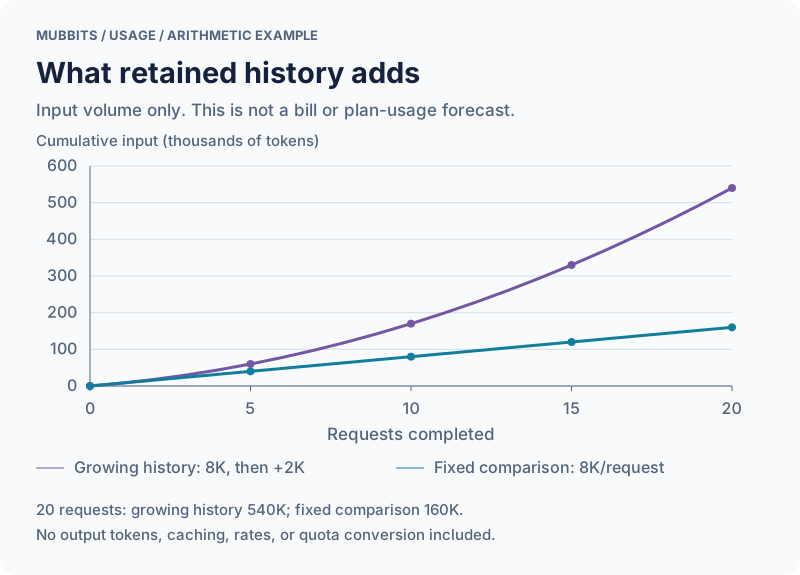
A graph of how accumulated context changes input volume
This simplified illustration compares twenty model requests. In the growing-history case, the first request carries 8,000 input tokens and each subsequent request adds 2,000 tokens of retained history. The twentieth request therefore carries 46,000 tokens. Summing the arithmetic sequence gives 540,000 input tokens across all twenty requests.
The comparison case holds each request at 8,000 input tokens, for a total of 160,000. That is a hypothetical bound for comparison, not a claim that real coding tasks can preserve all necessary information at a fixed size. The plotted series shows cumulative input after each request.
These totals do not determine the bill or a subscription percentage. Caching, cache writes, output tokens, reasoning, tool charges, and plan rules can affect actual consumption. The illustration isolates input volume so the effect of accumulated context is visible. It does not reuse a vendor price table or claim a measured optimization result.
Use the idea to inspect a real session: how large were the later requests, and which retained information still mattered? Keep the business constraints and evidence needed to finish the task. Removing context indiscriminately can create more retries and erase the savings you hoped to achieve.
| Requests completed | Growing history: cumulative input | Fixed 8K: cumulative input |
|---|---|---|
| 1 | 8,000 | 8,000 |
| 5 | 60,000 | 40,000 |
| 10 | 170,000 | 80,000 |
| 20 | 540,000 | 160,000 |
Cumulative input in a simplified twenty-request session
Reduce unnecessary input without losing the task
Give the agent a bounded outcome and let it inspect relevant code. Avoid requiring a complete repository read before every minor change. Keep stable architectural facts in concise repository guidance, and move rarely needed procedures into the workflow that uses them.
For command output, preserve useful errors and nearby context rather than repeatedly returning entire logs. A focused search can identify the relevant files before a detailed read. Keep full artifacts on disk when they may be needed for investigation, but do not assume the model needs every byte in every request.
Use a deliberate handoff when starting fresh: current objective, accepted decisions, changed files, verification results, and unresolved issue. A vague summary can lose the one constraint that mattered. Review the handoff before using it to continue a complex task.
OpenAI's September prompting guidance also recommends revisiting bloated instructions as models improve. The practical application here is to remove obsolete process requirements while preserving real engineering constraints. Shorter guidance is helpful when it makes the task clearer, not simply because it is shorter.
OpenAI, September 11: reduce stale prompting and instruction overhead
Can your team explain its coding-agent consumption?
Bring a representative task and sanitized usage records. We can help examine context, retries, model choices, and the cost of accepted work.
Check parallel work and scheduled activity
Claude Code's cost documentation identifies long context, cache misses, scheduled tasks, subagents, and active teammates among reasons consumption can grow. Use the available attribution view as a clue, and remember that local history may not include work from other devices.
Inventory the sessions and automations that can run under the account. Give each recurring job an owner, purpose, interval, and stopping condition. A task that checks unchanged state too frequently can consume resources without producing a useful result.
Parallel agents are appropriate when the work can be separated and the result justifies coordination. They are less useful when several agents read the same files and produce overlapping advice. Assign a concrete deliverable to each worker and stop completed or unneeded work.
For a blocked session, fix the environment or pause the dependent work rather than repeatedly asking the model to rediscover the same failure. Record the blocker and resume when the relevant condition changes. Continued consumption is not evidence of continued progress.
Route by task requirements and verify the cheaper path
Choose the least expensive configuration that reliably completes the task to the required standard. A routine formatting change and an ambiguous authorization refactor have different needs. Start with a small sample of each work category rather than assigning every task the highest reasoning effort by default.
Measure accepted changes, correction time, and rejected runs alongside consumption. A cheaper run that needs extensive repair may be expensive overall. Conversely, using a stronger model for an easy task can add cost without improving the result.
Keep a clear escalation rule. If the agent cannot resolve a specific ambiguity after a bounded attempt, provide better evidence or move to a stronger configuration. Do not let a task bounce indefinitely between models without preserving the investigation.
Use the same acceptance criteria when comparing configurations. Otherwise a lower-cost run can appear efficient because it skipped verification or returned an incomplete patch. The outcome should remain stable while the method changes.
Prepare a useful support report for unexplained discrepancies
If the account records still do not explain the behavior, gather a concise report: tool version, authentication path, plan or organization, timestamps, displayed usage, task category, and whether other sessions were active. Include sanitized screenshots or exports where supported.
State the observed discrepancy without assuming its cause. For example: the allowance changed between two timestamps while these sessions were active, and the available local attribution does not account for it. That gives support a concrete starting point.
Do not include API keys, cookies, raw credential files, or unnecessary customer data. A reproducible environment description is more useful than a large unredacted archive. Preserve the original evidence locally so details remain available if the vendor asks for a specific artifact.
After resolution, update the team's operating note with the confirmed explanation. Keep rumors and unverified account theories out of permanent guidance. Billing and reporting behavior can change with versions, so attach dates to conclusions that depend on a particular implementation.
Keep a small operating record for coding-agent work
A useful weekly record can stay simple: accepted tasks by category, notable failed runs, allocated spend or allowance observations, reviewer effort, and configuration changes. Choose measures the team can collect consistently. A complex dashboard that nobody maintains will not improve decisions.
Set thresholds that trigger investigation, such as a recurring failed task or a material increase in consumption for similar work. Decide who owns the response. Thresholds should lead to a concrete action rather than an automatic flood of status messages.
Review one optimization at a time. If context, model, reasoning effort, and tooling all change together, it becomes difficult to know which change helped. Preserve the previous setup long enough to compare representative outcomes.
The aim is predictable engineering work. A team that can explain its consumption, recover from a limit, and continue with a clear handoff is in a stronger position than one that only reacts by buying a larger plan.
Frequently asked questions
Does Claude Code's estimated session cost equal my subscription bill?
No. The current documentation distinguishes local session estimates from subscription usage and authoritative billing. Confirm the account, authentication path, and time window before comparing figures.
Can fewer prompts still use more allowance?
Yes. A prompt can trigger multiple requests, tool calls, retained context, and parallel work. Prompt count alone does not describe the resources used. Inspect the actual activity and the available attribution.
Does the context graph predict what my next session will cost?
No. It isolates cumulative input-token volume under stated arithmetic assumptions. Actual billing and subscription allowances depend on factors the illustration deliberately does not model.
Let’s work through your next step.
Tell us what you’re building, what you’ve tried, and where you need a hand. We’ll work with you to define a practical way forward.