

A cloud bill is a record of architectural and operational decisions. It reflects how much work the product performs, how efficiently that work is implemented, which reliability choices the team has made, and which resources remain running after their original purpose has disappeared.
Reducing the bill starts with understanding those decisions. Cutting every resource by the same percentage can damage the busiest customer workflows while leaving waste elsewhere. An illustrative SaaS business might discover that its main database is appropriately sized, while test environments, repeated exports, oversized media, and unbounded logs account for much of the avoidable spending.
This guide explains how to connect infrastructure spending to product activity, investigate the largest drivers, and make changes without sacrificing necessary reliability. The calculations are planning examples, not provider prices or promised savings. Use current invoices and measured workloads for decisions about your own environment.
Key takeaways
- Allocate costs to products, environments, and owners before optimizing individual resources.
- Track cost per useful business outcome alongside total spend.
- Investigate idle capacity, data movement, storage lifecycle, and inefficient work before buying commitments.
- Validate savings against latency, errors, recovery capability, and customer experience.
Build a cost map that someone owns
Start by grouping resources into production, staging, development, shared platform services, and experiments. Then associate each group with a product area and an accountable owner. Tags and account boundaries help, but a tag without a maintained definition can become another unreliable dataset.
Identify charges that do not map cleanly to a team, such as shared databases, network gateways, observability, and security tooling. Decide how to allocate them for planning. A simple documented method is often more useful than a precise-looking formula no one understands or trusts.
Reconcile the cost map with the actual invoice. Include credits, discounts, support charges, and commitments separately so a temporary credit does not conceal an increasing underlying cost. Distinguish billed cash spending from an amortized view where that helps explain a long-term purchase.
FinOps treats allocation and collaboration as part of ongoing financial accountability for technology. Apply that idea through a regular conversation between engineering, product, and finance. The objective is to understand what the business receives for its spending, not to assign blame whenever a graph rises.
Choose a unit that connects cost to value
Total spend can rise for healthy reasons, such as more active customers or more completed transactions. Define a unit that reflects the product’s work: a processed document, completed booking, active organization, streamed hour, or successful export. Different product areas may need different units.
For an illustrative reporting service, divide relevant monthly infrastructure cost by successfully completed reports. If cost rises while reports rise faster, unit efficiency may be improving. If cost stays flat while successful reports fall, the apparently stable bill can hide deteriorating economics.
Be explicit about what the unit includes. A customer may generate very different workloads depending on data size or usage pattern. Segment large and small jobs where necessary rather than averaging away the expensive behavior. Include failed attempts and retries in the cost numerator because the business pays for them too.
Pair the financial unit with service quality. A cheaper report that takes too long or produces incomplete results is not an improvement. Keep completion rate, latency, and correctness visible next to the spending measure.
Find idle and oversized capacity
Inventory resources that remain active when their workload is absent. Development databases, abandoned preview environments, unattached storage, old load balancers, and forgotten batch workers can persist long after a project ends. Assign an owner and an expiry policy to temporary environments.
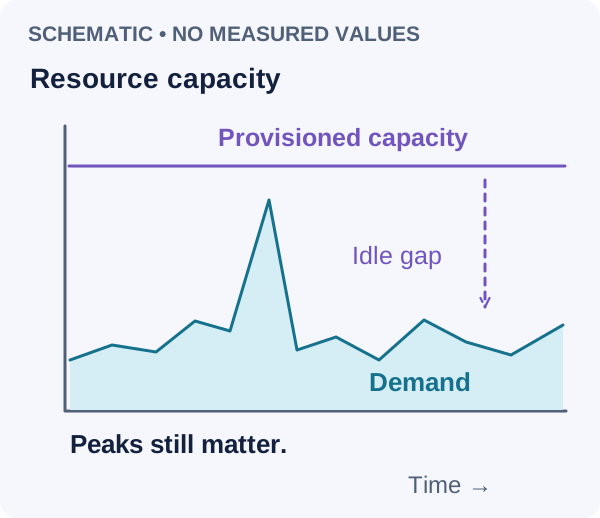
For active workloads, inspect utilization over a representative period. Average CPU alone is not enough. Memory, storage throughput, connection counts, queue depth, and short demand spikes may determine the required capacity. A resource that looks idle on one metric may be constrained on another.
Right-size in controlled steps. Change a low-risk workload first, observe its service metrics, and keep a rollback path. Avoid reducing capacity immediately before a known peak or a release that changes workload characteristics. Savings estimates should account for the capacity needed during realistic bursts.
Use scheduling where it fits. A nonproduction environment that is only needed during working hours may not need to run continuously, but teams need a reliable way to restore it. The operational friction of frequent manual restarts can outweigh small savings if scheduling is poorly implemented.
Average usage can hide the capacity question
Investigate expensive work before expensive machines
An inefficient query or repeated job can make any instance size look inadequate. Identify the operations responsible for resource consumption and connect them to application behavior. Look for unbounded queries, missing pagination, repeated external calls, unnecessary polling, and reports regenerated even when their inputs have not changed.
Inspect background jobs for duplicate scheduling and retry loops. A failed integration that retries immediately can consume compute, logs, and provider charges while producing no useful output. Add backoff, attempt limits, and a visible dead-letter or recovery process where appropriate.
Cache only when the validity rules are clear. A cache can reduce work, but stale permissions, prices, or account state can create serious product errors. Define the cache key, expiry, invalidation, and fallback behavior, then measure whether the cache actually avoids enough work to justify its complexity.
Optimize a known bottleneck rather than rewriting the whole application. A targeted index, smaller payload, or change in job scheduling can have a measurable effect with a smaller risk than a broad infrastructure migration justified only by a high bill.
Account for storage, retention, and data movement
Storage costs are more than the size of the primary database. Include replicas, backups, snapshots, object versions, exports, temporary files, and observability data. A product that generates a new copy of a large report on every request can accumulate substantial retained data without anyone explicitly choosing to keep it.
Define lifecycle rules according to business and recovery requirements. Decide which files are temporary, which are customer records, and which support an agreed retention obligation. Test deletion rules on representative nonproduction data before applying them broadly. A cost-saving policy that removes the only recoverable copy is not an optimization.
Trace data movement between regions, networks, services, and external users. Architecture can create repeated transfers that are invisible in application-level metrics. Large images, chatty APIs, and unnecessary cross-region processing deserve investigation alongside compute utilization.
Consider compression, sensible media sizes, and processing near the data when they fit the workload. Measure the full trade-off, including extra processing and operational complexity. Moving data less often can be valuable, but only if the resulting system still meets availability and access requirements.
Trying to understand a growing cloud bill?
We can help map costs to workloads and prioritize improvements around your reliability requirements.
Set an observability budget without losing evidence
Logs, traces, metrics, and recordings are essential for operating a product, but they need intentional collection and retention. Start by identifying which signals support an actual diagnostic or business decision. Repeated debug payloads and high-cardinality labels can create large volumes with little practical value.
Use structured events and consistent identifiers so engineers can investigate without storing every request body. Protect sensitive data and avoid treating monitoring tools as an unlimited archive of customer content. Define access and retention according to the information collected.
Apply sampling and tiered retention where they preserve the evidence you need. Keep important error and security events according to the relevant requirements, and verify that sampling does not make rare incidents impossible to diagnose. A blanket reduction can save money while silently weakening incident response.
Review observability cost after major traffic or instrumentation changes. New dashboards and tracing libraries can change volume significantly. Make the cost of a proposed signal part of the implementation discussion, while keeping the priority on being able to understand and recover the service.
Buy commitments only after understanding the baseline
Longer-term discounts can reduce the price of predictable usage, but they also create obligations. Before purchasing, establish which workloads are stable, which may migrate, and how much capacity is genuinely needed throughout the commitment period. Do not use a discount to make avoidable waste look acceptable.
Compare alternatives with the same assumptions. Include term length, payment timing, flexibility, coverage, and the possibility that demand changes. A headline discount can be misleading if the committed capacity is only partially used. Coordinate engineering forecasts with the people responsible for cash planning and contracts.
Separate stable baseline demand from variable peaks. A commitment may fit the baseline while flexible capacity handles bursts. Revisit the model after changes in customer mix, architecture, or product strategy, because yesterday’s stable workload may no longer exist.
Treat current provider terms as a procurement input that must be verified directly. This guide intentionally does not quote prices or universal savings percentages. The decision depends on your account, region, service, agreement, and actual pattern of use.
Keep reliability requirements visible
Some spending is the deliberate cost of resilience: backups, replicas, redundancy, spare capacity, and monitoring. Document the customer requirement behind each decision. That makes it possible to discuss whether the design is proportionate without casually removing a control that protects the business.
Define recovery objectives and test recovery. A backup that has never been restored is an assumption, and a cheaper architecture may have a longer recovery path than stakeholders expect. Compare the financial saving with the operational consequences in terms the business can understand.
AWS’s cost optimization guidance frames optimization as an ongoing practice within architecture decisions. Use that perspective when reviewing changes: cost, performance, reliability, security, and operational effort should be considered together rather than optimized in isolation.
For each material change, record expected savings, affected service metrics, rollout steps, and rollback criteria. Then compare the actual result. A small, verified saving is more useful than an impressive estimate that disappears when support effort and incident risk are included.
Include AI and third-party usage in the same model
A modern product’s technology costs may include model calls, search services, document processing, email, maps, and payment-related services as well as cloud infrastructure. Track these costs by the customer task that triggers them. Otherwise the cloud bill may look controlled while the total cost of delivering the feature rises elsewhere.
For AI features, record the model, input and output volume, retrieval work, tool calls, retries, and successful outcome. A long conversation or repeated agent loop can have very different economics from a single short classification. Set task-level budgets and limits that the application enforces.
Account for human review and exception handling when estimating value. Automation that shifts work into a review queue may still be worthwhile, but the economics should include that work. Avoid claiming savings based only on the time taken by the automated portion.
Create alerts for unusual spending patterns, but give them an owner and an action. An alert that repeatedly fires without a response is merely another data point. The team should know whether to pause a feature, reduce concurrency, investigate a customer, or change a configuration.
Establish a repeatable optimization cycle
Maintain a prioritized list of opportunities with an owner, expected benefit, confidence level, effort, and operational risk. Start with changes that are easy to verify and reverse. Use the results to improve the cost model before attempting larger architectural changes.
Review trends at a cadence appropriate to the business. A rapidly changing product may need frequent investigation, while a stable service may use a lighter review. Include upcoming launches and customer growth so the discussion is forward-looking rather than only an explanation of last month’s invoice.
Keep a record of realized savings and their assumptions. If a change reduces one provider charge but increases another, reflect the net effect. If usage grows, compare unit cost as well as absolute cost. This creates an honest history of engineering decisions and helps the business fund growth with a clearer understanding of what each additional customer or workload requires.
Frequently asked questions
What should we optimize first?
Start with visibility and obvious waste: unowned resources, expired environments, duplicate work, and retention that no longer serves a purpose. Then investigate the largest recurring cost drivers with workload data. Avoid beginning with a major platform migration unless the evidence shows that smaller changes cannot address the problem.
Is serverless always cheaper?
No. Economics depend on request volume, execution duration, memory, concurrency, supporting services, and operational requirements. Serverless can fit variable or event-driven work well, but sustained workloads may have different trade-offs. Compare the complete workload, including data transfer, storage, observability, and maintenance.
Should a startup use Kubernetes to control costs?
Only if the workload and team justify it. Kubernetes can provide useful orchestration capabilities, but it also creates platform work and does not automatically remove inefficient application behavior. A simpler managed deployment may be more economical for an early product. Evaluate total ownership rather than infrastructure features alone.
How do we know a saving is safe?
Define service-quality and recovery requirements before the change, roll it out gradually, and compare the resulting metrics. Keep a reversal plan and test important failure scenarios where appropriate. Savings should remain visible after accounting for increased support effort, slower workflows, and operational risk.
Let’s work through your next step.
Tell us what you’re building, what you’ve tried, and where you need a hand. We’ll work with you to define a practical way forward.