

Use an AI coding agent for a bounded repository change with a clear acceptance test and a reviewable diff. Give it the desired behavior, existing conventions and authorized tools; then verify the behavior independently of the tests it generated. The result should leave an engineer able to explain and operate the code.
This guide walks through an illustrative tenant-permission fix in a SaaS application. It includes a copyable task brief and a role/resource test matrix that expose missing access paths. Use it alongside your team's actual repository instructions and release process, rather than treating a tool's confident summary as completion.
Key takeaways
- Give the tool a concrete outcome, repository context, constraints, and a verification plan.
- Keep changes small enough for a reviewer to understand their consequences.
- Test behavior and failure cases independently of the generated implementation.
- Measure delivery quality and review effort alongside speed and adoption.
Choose work with a clear boundary
Good initial tasks have a defined outcome and an observable completion condition. Updating a validation rule, explaining a module, adding a missing error state, or migrating a well-understood API can be easier to verify than a broad instruction to improve the application.
For larger work, separate discovery from implementation. Ask the tool to identify relevant files, dependencies, and risks before changing them. Review the proposed boundary against the product requirement so an apparently convenient implementation does not solve the wrong problem.
Avoid treating every task as suitable for unattended execution. Changes involving authentication, financial calculations, data migrations, or destructive operations need stronger review and controlled access. The tool’s ability to edit those files does not establish that it should execute every resulting action.
Define what is outside scope. If the task is to fix a permission check, unrelated formatting, dependency upgrades, and interface redesign can make review harder. A focused change gives both the assistant and the reviewer a better chance of identifying the important consequences.
Provide context that explains the system’s intent
Explain the system's intent before prescribing a patch. In the illustrative SaaS task, job records belong to organizations; active membership grants read access, and a manager capability grants assignment access. The agent needs to inspect existing policies, list and export paths, and how membership changes invalidate access.
Use the copyable brief below as a starting point, then replace the policy with your product's approved rules and point to the actual repository examples. Keep fixtures synthetic. Read the discovered paths and assumptions before accepting an implementation that changes authentication or authorization.
For a small reversible task, this context can be short. For a consequential change, include the required review and release evidence. The brief gives the agent an outcome and boundaries while allowing it to discover the repository's correct implementation.
Task brief for a tenant-permission fix
Illustrative policy. Replace the domain terms and roles with your approved rules before using this in a repository.
Goal: close tenant-permission gaps for job records without changing approved access for active users.

Inspect the repository instructions and existing server authorization patterns first. Map detail, list, assignment, attachment and export paths, including background workers. Report the policy assumptions and affected files.

Policy: an active member may read only their organization's jobs. Assignment additionally requires the manager capability and an eligible assignee in the same organization. Revoked membership denies access even with an otherwise valid session. Tenant IDs supplied by a client are not authoritative.

Use synthetic tenants A and B. Verify same-tenant success, cross-tenant denial, insufficient-role denial, revoked access and alternate export/download paths. Derive expected results from this policy, not from the generated helper. Preserve the repository's documented error-disclosure behavior.

Keep the diff focused. Do not weaken checks, change fixtures to hide failures or add unrelated upgrades. Use only the development access authorized for this task; do not change production data or credentials.

Return the affected paths, final behavior, meaningful test results, remaining limitations and any release or rollback consideration. Produce a reviewable change through the existing release workflow.
Use plans to expose assumptions, not to create ceremony
For a consequential task, a short plan should identify the affected behavior, files, dependencies, and verification. It should make uncertainty visible before implementation. A plan that merely restates the prompt in numbered steps adds little value.
Ask specific questions during review: which existing callers will change, what happens to old data, which permissions apply, and how failure will be communicated. These questions help distinguish a technically plausible patch from a complete product change.
Keep the plan adaptable when inspection reveals new facts. If a supposedly local change crosses several services, revise the scope and explain why. Do not force the original plan through the repository simply because it was written first.
For small reversible fixes, a formal plan may be unnecessary. The principle is proportionality: use enough structure to make the work reviewable without turning every text adjustment into an architecture exercise. The tool should reduce coordination overhead rather than create additional process for its own sake.
Review generated code through behavior and boundaries
Start with what the change does for users and systems. Trace inputs, permissions, state changes, and outputs. Check whether the implementation handles the intended resource and organization, not merely whether the syntax looks idiomatic.
Look for changes that are easy to overlook in a large diff: removed validation, broader exception handling, altered defaults, weakened types, or tests changed to accept new behavior without justification. A patch can pass its own checks while quietly reducing assurance.
Review dependencies and abstractions critically. Generated code may add a library for a small task or create a generic framework around one use case. Prefer the simplest implementation that fits the repository’s conventions and foreseeable needs.
Keep human review meaningful by limiting change size. A reviewer cannot reliably assess a large set of unrelated generated edits simply because a summary sounds confident. Split work into coherent increments with a clear explanation of the problem, resulting behavior, and evidence.
Review the boundary, not just the changed lines
Test independently of the implementation’s assumptions
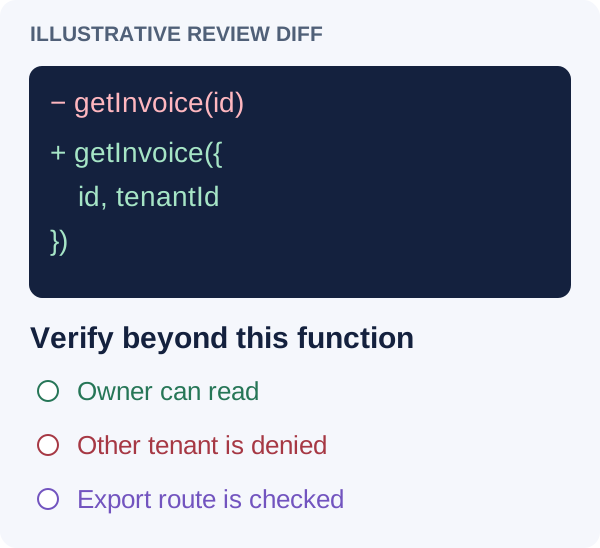
Derive expected results from the approved product policy before reading the generated tests. Then trace the real request paths, including exports, attachments and background jobs. A helper test is useful but cannot establish that every path calls the helper correctly.
For the illustrative job platform, the matrix below is an independent acceptance oracle. Use synthetic records from tenants A and B and verify responses and stored state. Add the product's documented status codes and disclosure rules; there is no universal 403/404 answer for every API.
Check that a mock has not removed the actual permission boundary. Reproduce the original defect, exercise the patched request and inspect adjacent behavior. The agent should report what it ran and what it could not verify. For interface or migration changes, add the corresponding browser check or data rehearsal through the existing release process.
| Actor and target | Approved outcome | Review question |
|---|---|---|
| Active member in A reads a job in A | Allowed under the read policy. | Did the patch preserve the legitimate success path? |
| Member in A reads or downloads a job in B | Denied without B data or a usable download link. | Do alternate paths enforce the same resource boundary? |
| Member in A changes a job's assignee | Denied when assignment capability is absent. | Is the check server-side and is stored state unchanged? |
| Manager in A assigns a user from B | Rejected as an invalid cross-tenant relationship. | Is the related record also authorized? |
| Revoked member reuses a valid session | Denied under current membership rules. | Does the implementation re-check authoritative access? |
| Export or worker selects records | Only authorized tenant records are processed or exposed. | Did the agent inspect this path rather than only the detail screen? |
Review the final pull request with behavior and security checks
Adding AI to your engineering workflow?
We can help define bounded agent tasks, independent verification and a rollout your engineers can maintain.
Keep security and tool permissions explicit
Grant development tools only the access needed for the task. Reading source code, editing a branch, running tests, publishing a package, and changing production data are different capabilities. Separate them where the environment allows and require appropriate authorization for consequential actions.
Treat repository files, issue text, logs, and external documentation as information that may contain untrusted instructions. A coding agent should not follow a command embedded in a log merely because it appears in the task context. Review how the tool distinguishes trusted instructions from material it is inspecting.
Check generated code for secret handling, injection risks, access-control gaps, and excessive data exposure. The assistant may reproduce an insecure pattern already present in the repository, so consistency alone is not sufficient when the task touches a sensitive boundary.
Keep an audit trail of meaningful changes and executed actions. A clear diff, command history, and test result make investigation possible. The objective is accountable assistance within the development process, not an opaque stream of edits that no one can explain afterward.
Use AI for exploration without mistaking it for evidence
An assistant can quickly suggest where a problem might originate, explain an unfamiliar function, or propose alternatives. Treat those outputs as hypotheses until checked against the repository, documentation, and runtime behavior. Confident explanations can be wrong about a subtle dependency or a version-specific API.
Ask for file references and inspect them. When the tool claims a behavior exists, verify the relevant code path or reproduce it. When it proposes a library API, check the installed version and official documentation rather than relying on a remembered example.
Use small experiments to resolve uncertainty. A focused reproduction, a type check, or a temporary benchmark can answer a question more reliably than a long discussion. Keep experiments separate from production changes unless they become useful maintained checks.
Encourage the team to preserve useful discoveries in normal documentation. The value should not remain trapped in one assistant conversation. A concise explanation of a tricky subsystem can help future developers whether or not they use the same tool.
Measure delivery outcomes rather than generated output
Track whether work reaches production sooner with acceptable quality, not how many lines or suggestions the tool produces. Include review time, rework, escaped defects, and the effort required to understand the result. More output can increase rather than reduce the team’s bottleneck.
DORA’s 2025 research describes AI as an amplifier of existing organizational strengths and weaknesses. That is a useful reason to improve task clarity, feedback, and delivery practices alongside tool adoption rather than expecting a tool alone to repair an unclear process.
Compare similar kinds of work and account for learning effects. A developer experimenting with a new assistant may initially move more slowly, while a short demo may exaggerate gains by selecting an easy task. Use a range of representative work and explain uncertainty in the results.
Ask developers where assistance is useful and where it creates friction. The answer may differ across debugging, boilerplate, test design, documentation, and architectural work. Adopt practices that improve the actual delivery system rather than requiring every task to use AI to satisfy an adoption metric.
Introduce coding agents gradually
Begin with tasks in an isolated branch or workspace, clear scope, and limited external access. Require a reviewable result with a summary of changes and verification. The agent should stop at a boundary it cannot safely or correctly cross rather than improvising credentials or deployment steps.
Expand the allowed task class after observing results. A reliable documentation update does not prove readiness for a production migration. Evaluate each category according to its consequences and the strength of the available checks.
Provide a recovery path. Version control helps reverse code changes, but generated commands may also affect databases, external services, or files outside the repository. Understand the environment’s permissions and keep destructive operations separately controlled.
Review recurring failures and improve the surrounding system. Better repository guidance, smaller tasks, clearer test commands, and reliable local setup can help both humans and agents. The goal is a development environment that supports correct work consistently, not an agent that succeeds only when a particular person supervises every step.
Keep engineering understanding in the team
Engineers need enough understanding to explain, maintain, and debug the code they accept. Use assistance to accelerate learning and routine work, but do not let the team become dependent on generating another patch whenever something breaks.
Ask reviewers to explain consequential decisions in plain language. Why is this permission checked here? What happens after a partial failure? Which data migration assumption is being made? If the answers are unclear, the change may need further investigation regardless of how quickly it was produced.
Maintain ownership of architecture and product trade-offs. AI tools can propose options, but the team must decide which constraints matter and accept the consequences. A strong practice uses automation to create more room for careful engineering judgment while preserving the evidence and understanding needed to operate the result.
Frequently asked questions
Can AI coding tools replace code review?
No. Automated review can help identify issues, but the team still needs accountable review of product behavior, security, architecture, and operational consequences. The depth should match the change. A tool that generated the implementation may share the same assumptions when reviewing it.
Should we let an agent run tests automatically?
Usually within an appropriately scoped development environment and the project’s authorized workflow. Understand whether tests access external systems, modify data, or require secrets. Routine local checks and consequential production operations should not be treated as equivalent simply because both can be launched from a terminal.
How should we evaluate a new coding assistant?
Use representative repository tasks with known acceptance criteria and compare completion quality, review effort, debugging, and security behavior. Include ambiguous requirements and failure cases. A benchmark or a polished demonstration can inform the evaluation but should not replace experience with the team’s actual codebase.
What makes a good task prompt?
State the desired behavior, relevant context, constraints, and how completion will be verified. Point to existing patterns and identify important edge cases. Avoid prescribing an implementation before the repository has been inspected unless that choice is a real requirement. Clear intent is more valuable than a long list of generic instructions.
Let’s work through your next step.
Tell us what you’re building, what you’ve tried, and where you need a hand. We’ll work with you to define a practical way forward.