

Your new paywall starts 40 more free trials. It also brings in USD 160 less. Which version would you ship? That’s the trap in mobile app paywall A/B testing: the first number arrives fast, while the number that pays for the product takes weeks. Pick the metric and the decision date before anyone sees the test. Then track the same group of users from assignment through trial, payment and refund.
Key takeaways
- Test one product decision at a time: where the paywall appears, how it explains the offer, or what the offer costs.
- If you change who sees the paywall, compare all eligible users assigned to each variant, including those who never see it.
- Use a fixed window that gives trials time to convert. Keep refund, support and product activation checks in the rollout decision.
Pick the moment you want to change
Picture a fitness app that asks for a subscription the second onboarding ends. Someone on the team wants to show the offer after the user completes a sample workout. That’s a useful hypothesis: experiencing one workout might make the value of the subscription clearer. Keep the same screen, products, prices and trial terms in both arms. Change when the offer appears. If the late version also has a different price or a longer trial, you’ll learn how the bundle performed but won’t know which change to keep.
RevenueCat’s 2026 report found median day-35 download-to-paid conversion of 10.7% for hard-paywall apps and 2.1% for freemium apps in its dataset. That’s a comparison across different apps using RevenueCat. Differences in audience, acquisition and product category can all matter. Use the gap as a reason to test the access decision in your own app; it doesn’t tell you what will happen if you move your paywall.
- If users reach checkout but hesitate, test a clearer explanation of what unlocks. Keep the total charge, renewal timing and trial terms visible in both versions.
- If users abandon before experiencing value, test when the offer appears and monitor whether they complete the first useful action.
- If you test price or trial length, log the actual store product and offer each user received. Keep presentation and timing fixed.
Count users before the paywall can change their path
For the placement test, randomly assign eligible first-time users when onboarding ends, before either version can send them down a different path. Store the assignment against a stable user ID. Keep it consistent across sessions, and define how anonymous and signed-in identities merge. A person who never completes the sample workout still belongs in the late-paywall group. If you count only paywall viewers, you’re comparing everyone who reached the early gate with the subset motivated enough to reach the late one.
Track assignment and first display as separate events. Log the experiment and variant IDs, app version, placement, platform, storefront and the actual offer shown. Join that record to the verified purchase and refund data; a button tap or a completed store sheet does not establish that the user paid. Before reading the result, check that assignments match the planned split. A large unexplained imbalance can signal broken assignment or tracking. Different display rates are expected in a placement test; different assignment rates need investigating.
Microsoft Research: how to diagnose sample ratio mismatch
Where to assign users in a placement test
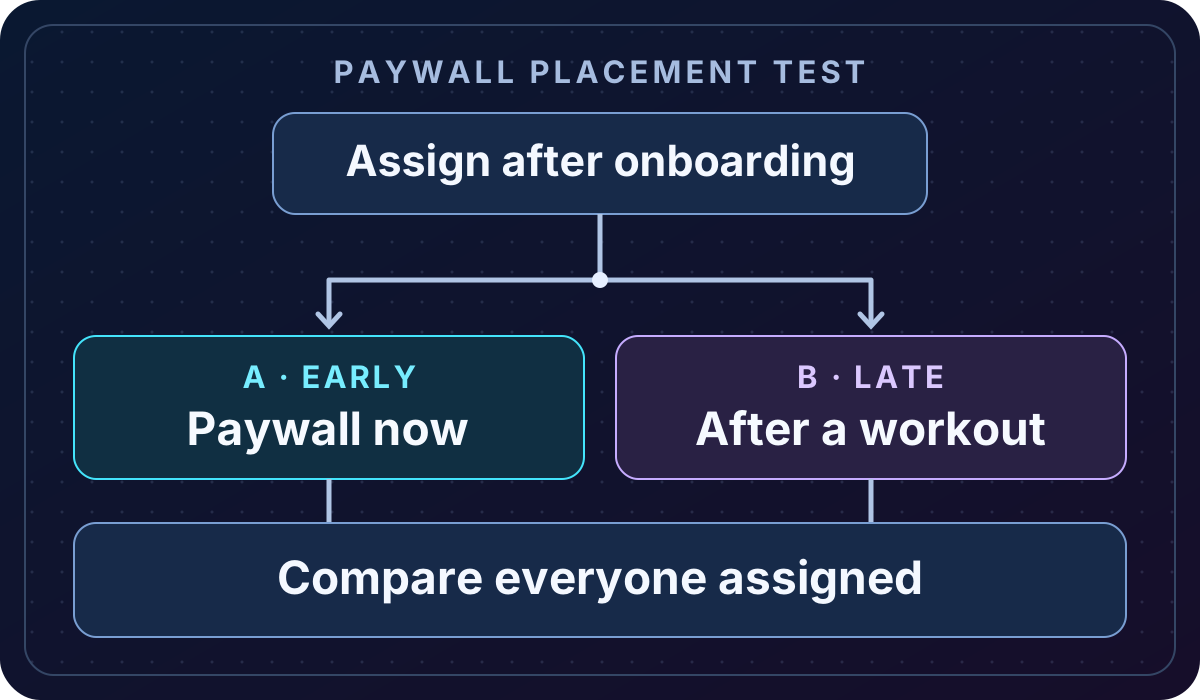
The scoreboard: 25% more trials, less money
Here’s a hypothetical 50/50 test. Both variants offer the same seven-day free trial and a USD 10 monthly plan. Each user has had 35 days since assignment. This example counts verified first payments less full refunds observed in that window; it excludes renewals, fees and taxes. There are no direct purchases in this example. For a price or plan-mix test, count the actual amounts rather than multiplying by a single price.
| Metric | A: after onboarding | B: after one workout |
|---|---|---|
| Eligible users assigned | 1,000 | 1,000 |
| Unique paywall viewers | 940 | 590 |
| Trials started | 160 (16% of assigned) | 200 (20% of assigned) |
| First payments before refunds | 64 (40% of trials) | 50 (25% of trials) |
| Full refunds | 4 | 6 |
| Refund-adjusted first payments | (64 − 4) × USD 10 = USD 600 | (50 − 6) × USD 10 = USD 440 |
| Revenue per assigned user | USD 0.60 | USD 0.44 |
- The late paywall wins on trial starts: 20% versus 16% of assigned users. It loses on refund-adjusted first-payment revenue per assigned user: USD 0.44 versus USD 0.60.
- Even paid conversion among paywall viewers would point the other way: 50 ÷ 590 is about 8.5%, while 64 ÷ 940 is about 6.8%. That view can help diagnose the screen. It can’t settle the placement decision.
- These are point estimates. Check uncertainty against the planned decision rule before calling either arm a winner. Keep tracking renewals if the business depends on retention beyond day 35.
RevenueCat: experiment results, trial conversion and realized revenue per customer
Can you trace a paywall view through to a paid subscription?
Bring your current offer, the funnel you can measure and the decision you need to make. We can help connect the in-app purchase flow, subscription access and experiment data.
Run the purchase path on both stores before opening traffic
Force each variant in an internal build, then follow it all the way to paid access. Apple’s sandbox supports testing storefronts and subscription events. Google Play’s license testers and Play Billing Lab let you exercise purchase and subscription states. Use them to check what the app displays and what the backend grants. Keep test purchases out of the production experiment dataset. When you intend to enroll users in the US, UK, Canada and Australia, verify what the store actually returns for those storefronts; don’t build an offer by replacing a currency symbol.
- Offer: verify the localized amount, billing period, trial eligibility and first charge. Try a returning customer who no longer qualifies for the introductory offer.
- Entitlement: verify purchase, restoration after reinstall or sign-in, interrupted payment, renewal and loss of access when appropriate. Confirm that a refund or cancellation updates access according to the actual subscription state.
- Fallback: try an unavailable product, a slow offer fetch and a failed checkout. Make sure a user can recover without being trapped behind a broken paywall.
- Attribution: trace one purchase and one refund for each arm. Verify that delayed or duplicate events don’t move a person to the other arm or count the same transaction twice.
Apple: test in-app purchases in sandbox
Google Play: test billing with license testers and Play Billing Lab
Set the rollout rule while the dashboard is empty
Write down the smallest improvement that would justify switching and use historical data to estimate how many users you need. Choose an analysis method and stopping rule up front. The calendar has two parts: time to enroll enough eligible users, then time for the last group of enrollees to reach the measurement age. A test that closes enrollment after 14 days with a 35-day outcome needs up to another 35 days before the final cohort is ready. An early pause for broken billing is sensible; declaring a winner after a good Tuesday is a different decision.
At review, confirm tracking is healthy, compare the primary metric and its uncertainty, and read the guardrails. If the revenue gain is meaningful and credible and guardrails hold, roll out gradually. If the evidence still allows a loss you couldn’t tolerate, keep the current variant and mark the result inconclusive. Look at platform or storefront differences for diagnosis; treat a surprise winner in a small subgroup as a hypothesis for another test.
Copy this one-page paywall test brief
Fill it out before enabling the experiment.
Decision: Keep the current placement or move it after the first completed workout.
Eligible cohort and assignment: New trial-eligible users; assign 50/50 at onboarding completion. Keep the same variant on return.
Change and constants: Placement only; same offer, screen and purchase flow.
Primary outcome: Verified first-payment revenue less refunds through day 35, divided by all assigned users.
Guardrails and pause thresholds: Activation, purchase failures, refunds and billing-related support. Name an owner for each.
Readout: Set the minimum useful difference, enrollment target, analysis method and final cohort cutoff before launch.
Rollout: Stage the winning variant and monitor purchase, access and support. Record the fallback to the control.
Budget for billing updates and regression testing after launch
Frequently asked questions
How long should I run a mobile paywall A/B test?
Set the enrollment target from your traffic, expected variability and smallest useful effect. Then give the final cohort the same time to convert and refund as the first. With low traffic, two variants and a larger, well-defined change usually give you a better chance of learning something than splitting the audience among many small design tweaks.
When is revenue per paywall viewer useful?
It’s useful for describing the screen when both groups enter the experiment at the same paywall trigger, before the variant can affect who reaches it. Still count eligible assigned users if either version can fail to render. For a test of placement, onboarding or access rules, use all eligible users assigned upstream.
Should a yearly plan win if it earns more in the first month?
Only for a decision specifically about near-term receipts, and only if the comparison treats fees, taxes and refunds consistently. A year of cash up front is not evidence of stronger retention. If you’re choosing a long-term plan mix, monitor usage, cancellation and renewal on horizons that make sense for both plans.
Let’s work through your next step.
Tell us what you’re building, what you’ve tried, and where you need a hand. We’ll work with you to define a practical way forward.